
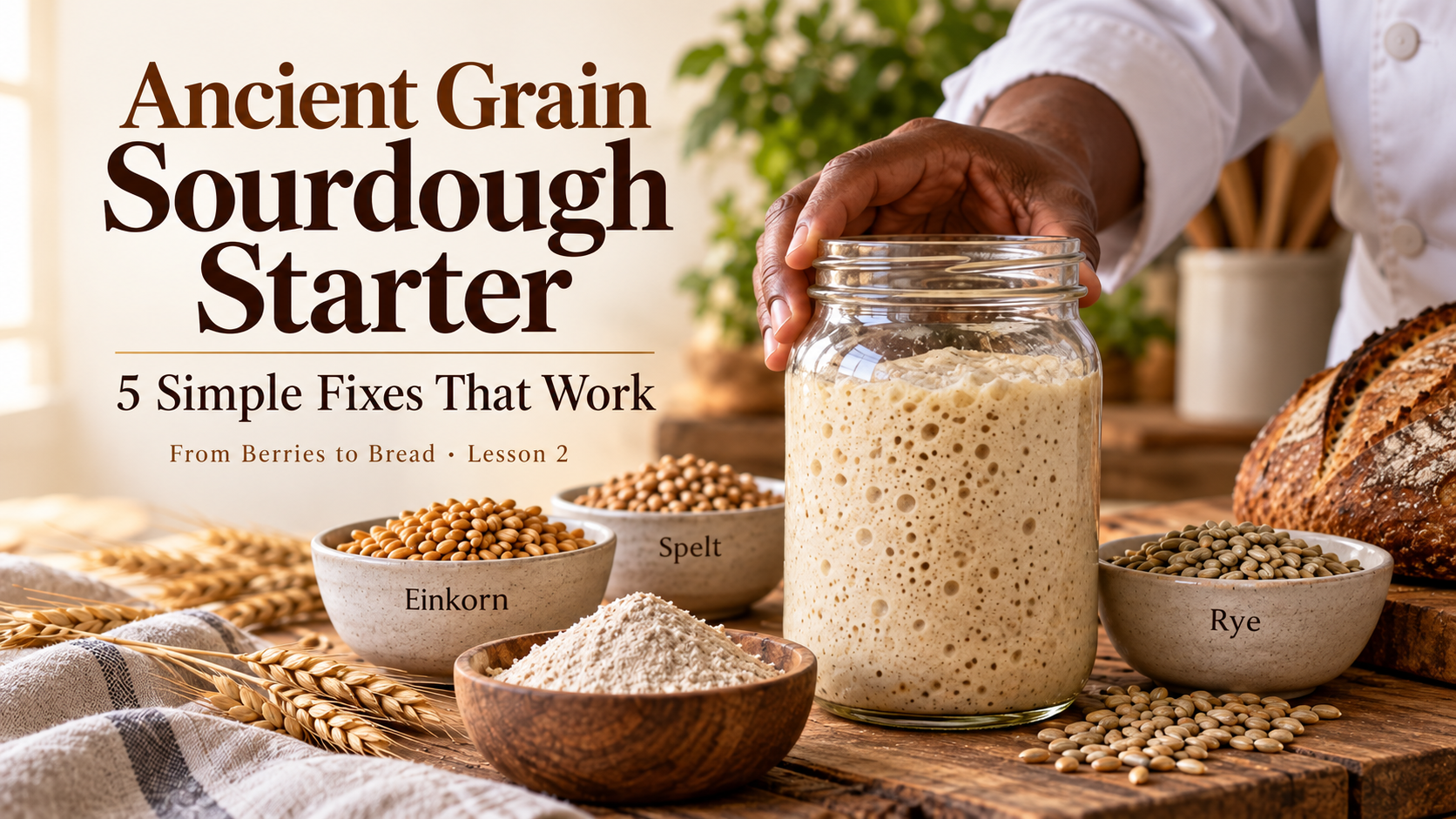
You changed the grain and your ancient grain sourdough starter stopped behaving. You didn’t forget how to bake overnight. You changed the engine.
Learning with us? This lesson is part of the free Ancient Grain Challenge. See how to register for the grain giveaway.
Here’s the ancient grain sourdough starter problem I want you to recognize. You’ve got a starter you trust. It doubles on schedule, it smells right, it floats. Then you open a bag of einkorn or rye, mill it fresh, feed the jar, and the next morning you’re staring at a sunken, soupy mess wondering what you broke.
You didn’t break anything. You changed the biological engine of your dough. To fix it, we have to look inside the jar.
Why Did My Ancient Grain Sourdough Starter Go Flat?
An ancient grain sourdough starter can go flat because it peaked before you checked it, or because its flour holds gas differently. Keep a backup of your usual starter, blend in the new flour gradually, and track bubbles, aroma, and rise over several feedings at a steady temperature.
Einkorn and spelt are ancient wheats. Rye is a different cereal, included here because it is useful in whole grain starters. Fresh-milled describes how flour is made; it does not make every grain an ancient grain.
Five practical fixes:
- Read activity and peak timing instead of relying on the float test.
- Let bran absorb water before changing your dough formula.
- Use gentle mixing suited to einkorn, spelt, and rye.
- Introduce new flour in a small, separate starter build.
- Keep temperature steady and record what happens after each feeding.
▶️ Watch the video lesson first
This post is the written companion to Lesson 2 of the From Berries to Bread series. The video walks through every slide.

Nothing Removed: Why Fresh-Milled Flour Acts Different
White flour is predictable because it’s been heavily refined. The bran and germ are gone. What’s left is mostly endosperm, starch and gluten-forming protein, and your starter has learned to live on that.
Fresh milling brings the entire wheat berry into the bowl. Different flour types bring different strengths. Nothing removed. That means three new players show up in your jar:
- The bran. Fiber that binds water and changes how the gluten network develops.
- The germ. Aromatic oils and nutrients that change flavor and fermentation.
- The microbes. Whole grain flour carries microbes and enzymes. Their activity varies with the grain, growing conditions, storage, and milling.
Whole grain flour brings more nutrients and different water absorption into the jar. An ancient grain sourdough starter may peak sooner and look different. Track its behavior before you change the feeding schedule. That’s information.

Does a Sourdough Starter Have to Float?
No. A sourdough starter does not have to float to be ready. The float test measures trapped gas, so flour type, hydration, and handling can change the result. Judge readiness from a repeatable rise after feeding, bubbles throughout the jar, and a clean fermented aroma.
Activity and gas retention aren’t the same thing. A whole grain or einkorn starter can be bubbling away, fully alive, and still sink like a rock. Sinking doesn’t mean dead. It may mean the starter holds less gas, has already passed its peak, or lost gas when you scooped it.
So stop dropping spoonfuls in water and panicking. Watch the jar. Smell it. Look at the surface. King Arthur Baking’s float-test comparison shows why floating alone is unreliable. I’ll give you what to look for below.

The Bran Factor: Why Your Dough Feels Like Soup
Fresh-milled whole grains absorb water differently. The bran works like a slow sponge. It soaks up water over time and competes with the gluten for moisture. Right after mixing, the dough feels slack and sticky. Rest the flour and water for 20–30 minutes, then reassess. Some doughs become easier to handle; the result depends on the grain and flour grind.
The rule is simple:
- Sticky doesn’t mean wet.
- Hold some water back when you mix.
- Give the flour time before you give it more flour.
Most bakers make the same mistake here. They feel the stickiness, dump in more flour, and an hour later they’ve got a brick. Patience fixes this. Extra flour doesn’t.
The Einkorn Illusion: Protein Isn’t Strength
Einkorn is one of the oldest wheats we have. It carries 14 chromosomes, a far simpler genetic structure than modern bread wheat, which carries 42. It can test high in protein, but the gluten it builds is a completely different animal.
Einkorn dough is extensible. It stretches beautifully. It generally has less elasticity than strong bread wheat, so it does not snap back the same way. Spelt sits in a similar spot: silky and stretchy, but it relaxes fast and tears if you overwork it.
Here’s the thing. Stop kneading an ancient grain trying to force it to act like modern wheat. You aren’t building strength. You’re tearing a fragile network. Gentle folds, shorter mixes, and a lighter hand.

The Rye Exception
Rye plays by its own rules. It does contain gluten-forming proteins, but they don’t build the elastic network we expect from wheat. Rye gets its structure from starch and a group of water-binding compounds called arabinoxylans, sometimes called pentosans. They’re the reason rye can hold so much water.
That’s why your rye starter feels like thick paste instead of a stretchy web. Stop waiting for rye to act like wheat. It’s never going to.
Hyper-Active Amylase
Rye has another quirk. Its starch gelatinizes at lower temperatures than wheat starch, and its alpha-amylase enzymes stay active longer into the bake. Amylase breaks starch down into sugar. If it keeps chewing on the starch while the loaf bakes, the structure collapses and you get that gummy, sticky ring under the crust.
Acidity Is Structural
This is why many traditional high-rye breads use sourdough. In high-rye baking, acidity is about more than a sour flavor. The acid from your starter slows the amylase down and protects the starch structure. The sour is doing a job. In a rye loaf, a well-acidified starter is part of the architecture. King Arthur Baking explains how acidity protects rye bread structure.

How to Switch to an Ancient Grain Sourdough Starter: The Blending Strategy

Can I Feed My Existing Starter Einkorn, Spelt, or Rye?
Yes. Feed a small portion of your existing starter with the new flour while keeping your usual starter as a backup. Begin with 25% new flour and 75% familiar wheat flour by weight. Keep the feeding ratio and temperature steady, then increase the new flour once its timing becomes predictable.
My starting ratio:
- 25% new grain (einkorn, spelt, or rye). This introduces the new flour while keeping the change easy to observe.
- 75% hard white or hard red wheat. This keeps the elastic, structural base you already know how to read.
Here’s what that looks like on a small 1:2:2 feed:
- 20g (0.7 oz) active starter
- 30g (1.1 oz) fresh-milled hard white or hard red wheat
- 10g (0.35 oz) fresh-milled einkorn, spelt, or rye
- 40g (1.4 oz) water at about 78°F / 26°C
The 25% refers to the flour you add at this feeding, not the whole jar. A 1:2:2 feed means one part starter, two parts flour, and two parts water by weight. These flour and water percentages make feeding changes easier to compare. Use a scale to keep the comparison consistent. Feed your ancient grain sourdough starter this blend for a few cycles until the timing settles, then move up to 50% if you want to push further.

Keep Your Ancient Grain Sourdough Starter Temperature Steady
This post contains affiliate links. If you purchase through them, we may earn a small commission at no extra cost to you. We only recommend products we use and trust.
Whole grain flours often ferment faster than refined white flour, but temperature, feeding ratio, and starter maturity also affect timing. If you change the grain and let your kitchen temperature swing all over the place, you’ll never learn how the grain actually behaves. You won’t know if the jar peaked early because of the einkorn or because the kitchen hit 80°F / 27°C.
Control the temperature. Read the grain. I keep my starter in a SourHouse Goldie for exactly this reason. Steady temperature means the only thing changing is the flour. Use code HBK26 at checkout. A cooler with a jar of warm water can also help; check the actual temperature with a thermometer. The point is consistency, not a gadget.
Reading the Starter: The Diagnostic Matrix
For your ancient grain sourdough starter, use these texture clues alongside a marked starting level and a feeding log. Aroma varies with the culture; no single smell proves readiness.

- Einkorn: Gets softer and more liquid. Modest rise, tends to spread. Look for bubbles throughout the jar and a repeatable rise after feeding. Aroma can be mild or tangy.
- Spelt: Silky and very extensible. May form a dome, then relax quickly. Watch the jar before the surface falls and compare several feeding cycles.
- Rye: Thick, paste-like, very viscous. Expands fast, often with a flat or cracked top. Deep earthy, malty smell. It can peak quickly, so check it more often after a flour change.
- Hard red or hard white: Elastic, strong web. Tall, distinct dome. Pull a spoonful and you’ll see the classic webbed structure.
If it rises and falls before the next feeding: check earlier, move to a slightly cooler spot, or increase the feed ratio while keeping the flour blend constant. Change one variable at a time. Keep a simple starter maintenance log so you can repeat what works. Use your ancient grain sourdough starter near its observed peak once its cycle is repeatable.
If activity stays weak: keep feeding consistently and compare it with your backup before baking. A mature ancient grain sourdough starter should show a repeatable cycle; a new culture needs more time. Discard a starter with fuzzy mold or pink or orange discoloration.

A Simple Feeding Log for Your Ancient Grain Sourdough Starter
Before changing the flour again, make the next feeding something you can compare. You do not need a laboratory notebook. A strip of tape on the jar and a few notes on your phone will do. Mark the level immediately after feeding, then write down the grain blend, starter weight, flour weight, water weight, and temperature. Note when bubbles appear, when the top reaches its highest point, and when it begins to flatten.
Your Ancient Grain Feeding Log
Copy this into a notebook, print it, or keep it on your phone. Fill in one row every time you feed. After three or four feedings with the same grain, ratio, and temperature, you’ll see your starter’s real rhythm. That rhythm is what you plan your bake around.
| Date & time fed | Grain blend | Starter : flour : water (g) | Jar temp | Peak (time & height) | Notes: bubbles, texture, smell |
|---|---|---|---|---|---|
| Example: Mon 8:00 am | 100% fresh-milled einkorn | 20 : 40 : 40 | 76°F / 24°C | 1:30 pm, about 1.5x | Soupy, bubbles all through, mild tang |
Rather keep it digital? The Starter & Levain Studio does the math and the logging for you. Pick einkorn, spelt, emmer, Khorasan, or rye as your flour, weigh your feed, and save each feeding to the journal. It’s free, no account needed, and it stays in your browser.
Keep the comparison fair. Use the same jar shape, flour blend, and feed ratio for several cycles. A wide jar can make the same expansion look shorter than it does in a narrow jar. Photograph the side of the jar at feeding and near the peak. That gives you a much better reference than trying to remember whether yesterday’s starter looked taller.
Read the pattern before changing the ratio. If your ancient grain sourdough starter repeatedly peaks while you are asleep, it may need a different feeding schedule. A larger feed gives the culture more fresh flour relative to the starter and can lengthen the cycle under otherwise similar conditions. It also changes the comparison, so record it. Do not increase the feed, move the jar, and switch the grain on the same morning.
Separate a flour change from a new starter. A mature culture that you are adapting already has a feeding history. A brand-new flour-and-water culture does not. Early bubbles in a new culture are not enough to establish that it can raise bread reliably. Continue following a starter-building method and look for repeatable activity before using it as your only leavening.
Test the flour in a small bake. Once the feeding pattern becomes predictable, try the new blend in a familiar recipe and keep notes on the dough too. A lively starter does not make einkorn dough behave like strong bread flour. If you change the starter flour and all the flour in the loaf at once, you have made two experiments. Keep one familiar so the other can teach you something.
The useful result is a schedule you can repeat in your own kitchen. Record what actually happened, including a quiet feeding or a missed peak. Those notes tell you when to check the jar next time and help you decide whether another grain change is worth making.
Taste the Grain
For years, we used white flour as a neutral glue to hold fermentation flavors together. Ancient grains change that. Flour isn’t just the structure anymore. It’s the defining ingredient.
That’s the whole point of this series. Know the grain. Mill the flour. Read the dough. The grain for this series comes from Grand Teton Ancient Grains, and if you missed the start, read how the mill landed on my counter and why fresh flour changes your dough. When you’re ready to bake, the fresh-milled recipes are waiting in the Recipe Pantry Fresh-Milled & Ancient Grains section.

Join the Ancient Grain Challenge and Grain Giveaway
Put this lesson to work with us. The free Ancient Grain Challenge from Crust & Crumb Academy takes you through seven short lessons on ancient grains and fresh-milled flour, with grain prizes provided by Grand Teton Ancient Grains.
Register now, then learn at your own pace. You do not need to finish a lesson or quiz before signing up, and no Academy membership or payment is required.
Register Free for the Ancient Grain Giveaway
- Complete at least one lesson to qualify for the weekly Friday drawings.
- Complete all seven lessons to qualify for the December 1, 2026 final prizes, including the 25-pound grand prize.
- Thirty winners will each receive a 5-pound bag of grain across the giveaway.
For lesson credit, watch the required video or videos, pass the quiz at 70% or better, leave your YouTube comment, and record completion on the lesson page. Likes and subscriptions are optional and do not improve your odds.
No purchase necessary. Open to U.S. and Canadian residents age 18 or older; void where prohibited. Entries close November 29, 2026. Read the official rules and prize details.
Questions about your jar? Bring them to Crust & Crumb Academy. Post a photo of your starter and tell me what grain is in it. We’ll read it together.
Keep Baking With Us
Bring your questions to Crust & Crumb Academy, then find your next bake in the Recipe Pantry.

Perfection is not required. Progress is.
Keep Your Starter Temperature Steady
SourHouse Goldie and DoughBed are tools for steadier fermentation temperatures. Use code HBK26 at checkout.

Henry
Leave a Reply