
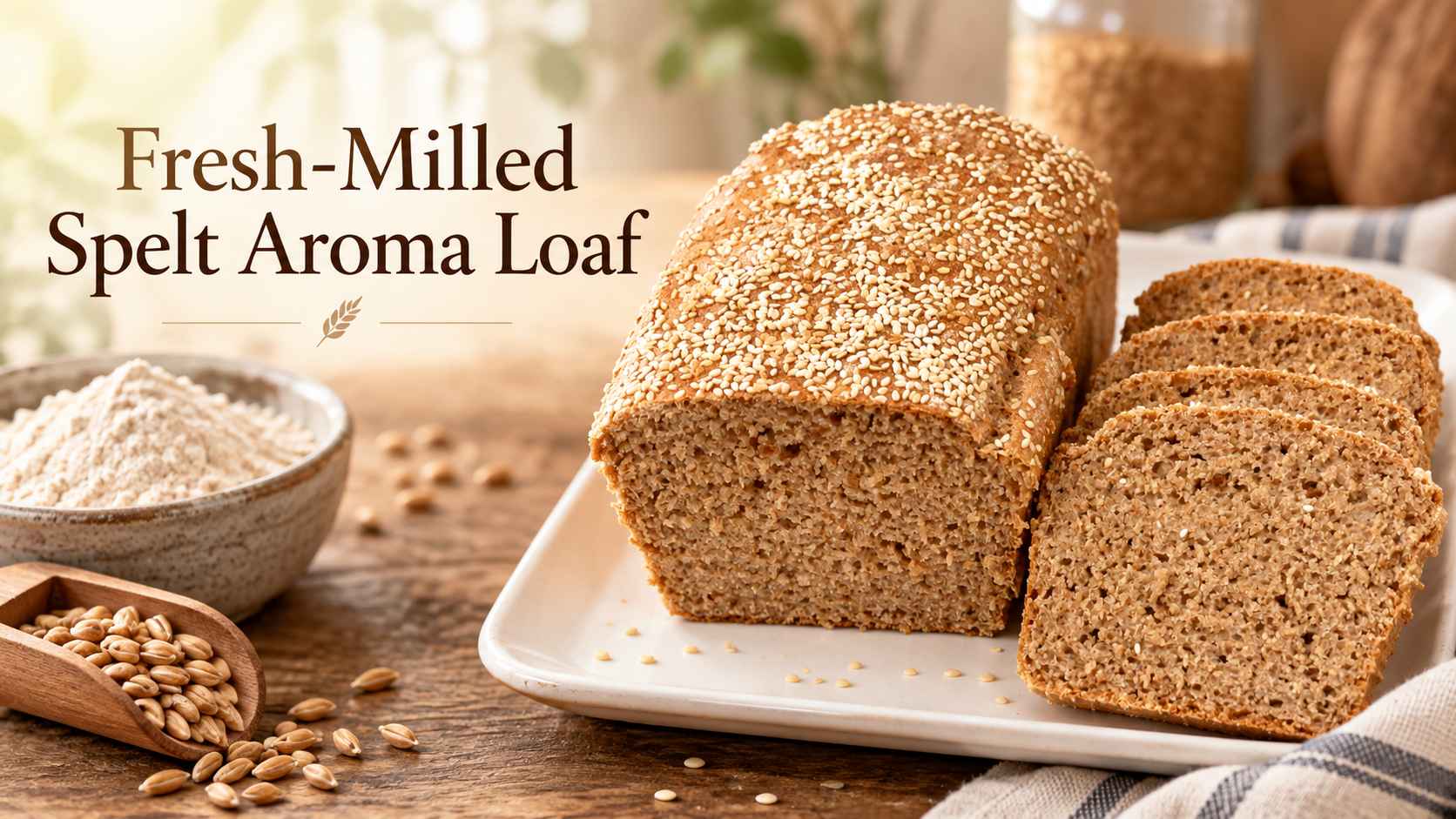
Spelt Aroma Loaf
The first time I mixed this fresh milled whole grain bread, I thought something had gone terribly wrong.
It didn’t look like bread dough.
It looked like drywall spackle.
I scraped it out of the mixer, practically plastered it into the loaf pan, smoothed the top, and stood there wondering how something that looked like that was ever going to become bread.
Then it started rising.

And when I finally cut into this fresh milled whole grain bread, I found a soft, moist, evenly aerated crumb that was nothing like what the dough had led me to expect.
That fresh milled whole grain bread became one of the best lessons I’ve had since I started milling grain at home.
Fresh flour changes the rules for fresh milled whole grain bread.
And spelt really makes you pay attention when you bake fresh milled whole grain bread.
Why I Wanted to Bake This Fresh Milled Whole Grain Bread
The idea started with a video from an Austrian bakery making a 100% whole-grain spelt loaf.
They weren’t simply milling spelt to make fresh milled whole grain bread.
They were treating the same grain in several different ways before bringing everything together.
There was an aroma dough.
A spelt sourdough.
And something called a Kochstück, a cooked flour preparation used to hold considerably more water in the finished bread.

Then everything went into a very wet final dough with sunflower and sesame seeds.
That got my attention.
Instead of asking, “How much whole-grain flour can we get into this bread?”
The better question was:
What can we make this grain do?
It Starts With the Grain
For this fresh milled whole grain bread, I started with whole spelt berries from Grand Teton Ancient Grains.
Spelt is an older wheat variety with a sweet, nutty flavor that becomes especially noticeable when freshly milled. King Arthur also notes that freshly milled spelt can absorb more water than aged spelt flour, which matters when you begin working with higher-hydration doughs. (King Arthur Baking)
And that brings us to something I want home bakers to understand.
When you mill grain yourself, you’re not simply making a homemade version of the flour sitting on the grocery-store shelf.
You’ve changed the ingredient.
The flour is fresh.
The bran and germ are still there.
Its aroma is different.
Its water absorption can be different.
And the dough may feel completely different under your hands.
That’s why fresh-milled baking gets frustrating when we keep expecting the dough to behave exactly like dough made with conventional white flour.
It won’t.
And it shouldn’t.
Milling Spelt at Home
I milled the berries in the NutriMill Classic.

There’s nothing complicated about this part. Spelt is one of the grains the Classic is designed to mill, and for this bread I wanted a fine whole-grain flour rather than a cracked grain. (NutriMill)
For this fresh milled whole grain bread, I needed:
450 grams of whole-grain spelt flour.
I milled the grain first, then divided the flour between the different stages of the recipe.
That’s where this fresh milled whole grain bread gets interesting.
We’re taking one grain and asking it to do three different jobs before we ever mix this fresh milled whole grain bread.
Stage One: The Aroma Dough
The first portion of flour becomes an aroma dough.

It’s simple:
Spelt flour.
Water.
A tiny amount of yeast.
Then time.
It sits overnight and begins developing fermentation flavor before it ever reaches the main dough.
This isn’t about creating tremendous strength or rise.
It’s about flavor development.
Instead of trying to build all the character of the loaf during one fermentation, we begin developing it the night before.
Stage Two: The Spelt Sourdough
The second portion becomes a sourdough build.
Again, we’re using the same spelt.
But now we’re asking something different from it.
The sourdough brings fermentation, acidity, aroma, and another layer of flavor.
This is one of my favorite things about this formula.
We haven’t added a dozen ingredients to this fresh milled whole grain bread.
We’re creating complexity by changing how we treat the grain.
That’s an entirely different approach to bread.
Stage Three: The Salted Kochstück
Then comes the part many American home bakers may not have encountered.
The Kochstück.
Pronounced roughly KOHKH-shtook, it simply means a cooked piece or cooked portion.
Flour is combined with hot water so the starch gelatinizes and holds onto considerably more moisture.
If you’ve made tangzhong or yudane, the idea should feel familiar.
Different traditions. Similar underlying idea.
We are using heat and water to change what the flour can do inside the finished loaf.
For this fresh milled whole grain bread, the Kochstück contains:
Whole-grain spelt flour.
Boiling water.
Salt.
It becomes a thick paste and rests overnight.
And now we have three preparations sitting on the counter.
Same grain.
Three completely different jobs.
Then Everything Comes Together
The next day, the aroma dough, sourdough, and Kochstück go into the final mix with the remaining fresh-milled spelt.

Then we add sunflower and sesame seeds.
And this is where you have to forget what you think fresh milled whole grain bread dough is supposed to look like.
Mine didn’t form some beautiful Instagram-ready dough ball.
It was extremely soft.
Sticky.
Heavy.
Almost batter-like.
I called it drywall spackle, and I still think that’s the best description.
But here’s the important part.
I didn’t start throwing flour into it.
That’s one of the easiest mistakes to make with unfamiliar whole-grain dough.
We see sticky dough and immediately think:
More flour.
But adding flour changes the formula.
Sometimes sticky isn’t a problem.
Sometimes sticky is simply what the dough is supposed to be.
Fresh Milled Whole Grain Bread Makes You Read Dough Differently
This is probably the biggest lesson from the loaf.

Baking fresh milled whole grain bread requires us to stop looking for dough to behave exactly like conventional bread dough.
Fresh-milled spelt brings the entire grain into the bowl.
And spelt itself behaves differently from modern bread wheat.
So instead of asking:
“Does this look like the sourdough I normally make?”
I started asking:
“Is it becoming cohesive?”
“Is fermentation happening?”
“Is it holding the gas we’re producing?”
“Is it rising in the pan?”
That’s reading dough.
And it’s much more useful than trying to make every dough look the same.
No Traditional Shaping Required
There was no boule.
No batard.
No elaborate shaping.
I scraped the dough directly into a loaf pan and smoothed it with a wet hand.
Plastered might be the better word.
Then I waited.
Slowly, that strange-looking mixture began moving upward.
Eventually it formed a rounded crown just above the rim of the pan.
That’s when I baked it.
And this is what came out.

Then came the real test.
The crumb.
Soft.
Moist.
Even.
Sliceable.
Not the dense brick people sometimes expect when they hear “fresh milled whole grain bread.”
What Each Stage Actually Did
Once I cut into this fresh milled whole grain bread, the architecture of the recipe made sense.
The aroma dough brought flavor.
The sourdough brought fermentation and acidity.
The Kochstück brought moisture and tenderness.
The fresh-milled spelt brought the grain itself.
Not just flour as a background ingredient.
The actual flavor and character of spelt.
That’s the part of fresh milling that’s beginning to fascinate me.
You’re not simply substituting one flour for another.
You’re learning what each grain wants to become.
Should You Mill Flour at Home?
You don’t need a grain mill to be a good bread baker.
Not remotely.
But if you’re curious about whole grains, ancient grains, and how flour behaves before it has spent months sitting on a shelf, milling opens another door.
For me, that’s what this project is about.
Not making bread more complicated.
Understanding the ingredient better.
I used a NutriMill Classic for this loaf because that’s the mill currently sitting on my counter, and the spelt berries came from Grand Teton Ancient Grains. Those are partners in the Ancient Grain project we’re building, but they’re also simply the tools and grain I’m actually using in my kitchen.
You’ll see them because you’re following the bake with me.
Not because I want this to turn into a commercial.
The Recipe
I’ve put the complete recipe for this fresh milled whole grain bread — the Whole-Grain Spelt Aroma Loaf — into the Recipe Pantry with the overnight builds, final dough, proofing cues, baking temperatures, and everything I learned from this first bake.

If you make it, I want to know what happens in your kitchen.
Fresh-milled flour changes from grain to grain, mill to mill, and kitchen to kitchen.
That’s exactly why we’re doing this together.
Bake it.
Cut it open.
Take pictures.
Compare notes.
That’s how we learn.
Want to Go Deeper Into Fresh-Milled Flour?
This fresh milled whole grain bread is part of our growing work with ancient grains and freshly milled flour inside Crust & Crumb Academy.
We’re milling the grains, learning what they taste like, figuring out how they handle water, seeing what fermentation does to them, and turning all of that into bread that a home baker can actually make.

No gatekeeping.
No expectation that you already know the vocabulary.
We’re learning by baking.
Come bake with us.
From Berry to Bread | Ancient Grains, Fresh-Milled Flour & Better Bread

In From Berry to Bread, I’m introducing our Ancient Grain Series inside Crust & Crumb Academy. We’re going back to the beginning, learning the grains themselves, milling fresh flour, watching how different wheats behave in dough, and understanding what changes in fermentation, texture, aroma, and flavor.

Leave a Reply