
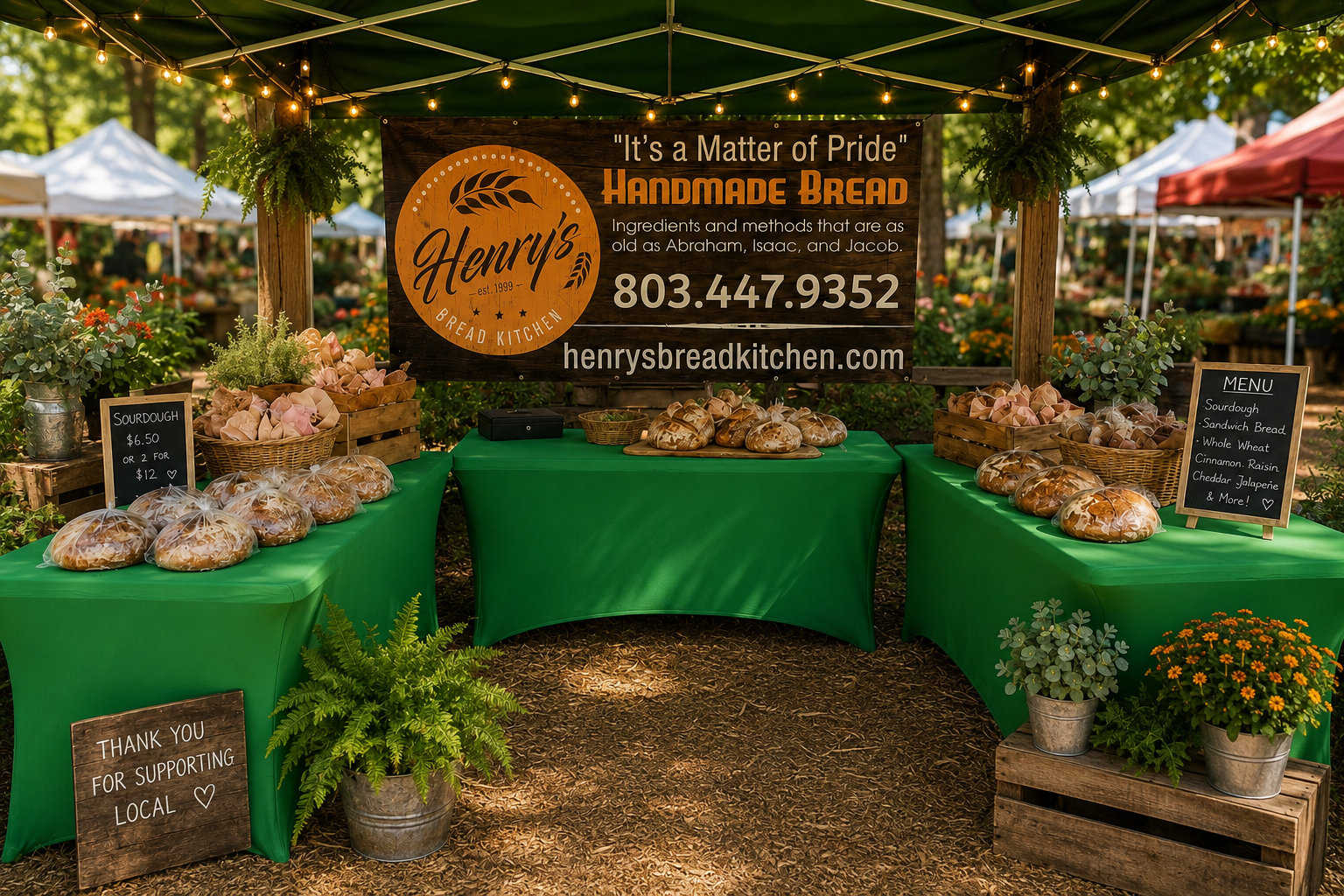
The $8 Cinnamon Roll Argument
The people telling you your farmers market cinnamon rolls cost too much were never going to buy one.

Somebody posts in a baking group: “Thinking about selling my cinnamon rolls at the market. Is $8 too much?”
Forty comments. Most of them some version of “I’d never pay that.” A few people mention what a grocery store four-pack costs. Somebody says they can make them at home for pennies.
And the baker deletes the post and prices at $4.
I’ve watched this happen a hundred times and it makes me want to put my head through a wall, because almost none of those commenters were ever going to buy a cinnamon roll from her. They were answering a different question. She asked “what is this worth,” and they answered “what would I personally spend on a Tuesday.”
Those are not the same question. One of them has an answer you can look up.
Run the actual math
Ingredients for a dozen cinnamon rolls land somewhere between $12 and $20 depending on your butter and your flour. Call it $15. That’s $1.25 a roll.
Now the part nobody counts. A dozen rolls from scratch, mixing through glazing, is three to four hours of your hands. Pay yourself $20 an hour and that’s $60 to $80 of labor sitting in one pan.
$15 ingredients + $70 labor = $85 for twelve rolls
Add packaging, market fee, utilities and you’re past $90
$7.50 a roll before you’ve made a dime
That’s the real math on farmers market cinnamon rolls before you’ve sold a single one, and it’s why so many farmers market cinnamon rolls get priced by guesswork instead of by the batch.
So when somebody tells you $8 is too much, what they’re actually saying is that your time is worth nothing. Which is exactly what most home bakers agree to, right before they burn out.
The number that changes everything
Here’s the part the comment section will never tell you, and it’s the reason the answer isn’t just “charge more.”
That same three to four hours doesn’t make twelve rolls. It makes seventy-two.
The mixing is the same. The proofing is the same. The rolling and cutting scale almost linearly, and your oven doesn’t care whether it’s baking one pan or six. Batch six dozen and your labor per roll drops from around $5.80 to under a dollar.
Now $8 isn’t a defense. It’s a business. Same product, same price, same customer, completely different life.
Price and batch size are one decision, and almost everybody treats them as two. When a price feels impossible to defend, the problem is usually how many pans you’re making, not the number on the sign.

Every batch of farmers market cinnamon rolls tells the same story: price the pan, not the panic. Once you see farmers market cinnamon rolls this way, $8 stops being a debate.
What the market actually pays
While the comment section was arguing, here’s what was happening in the real world.
Artisan cinnamon rolls at specialty bakeries: $4.50 to $7 each
Oversized jumbo rolls: $7 to $10
Farmers market cinnamon rolls: $5 to $6 a roll, or $48 to $60 a dozen
So $8 sits at the top of the range, which makes it defensible but not automatic. You have to earn the top of a range, and that means the roll has to look like an $8 roll from ten feet away. Size, height, a filling somebody can name, a glaze that photographs. Nobody pays a premium for a roll that looks like the tube.
The one I built for Recipe Pantry Pro, a brown butter peach cobbler roll with buttermilk glaze and streusel, I priced at $6 with a $5 to $7 range. That’s a premium roll and I still didn’t reach for $8, because the price has to match what’s actually on the table that morning.

The wrinkle that eats your margin
One more thing, and this one has nothing to do with pricing.
Cream cheese frosting is fresh dairy. In a lot of states that puts it outside what cottage food law allows you to sell from a home kitchen. Bakers find this out after they’ve built their whole brand on it.
The fix is a shelf-stable glaze that tastes like it earned its place, not a sad compromise. But you need to know that before you print the sign, not after an inspector reads it. Check your own state’s list before you finalize a single menu item.
Most bakers price by feel. They look at what the bakery down the road charges, or they just pick a number that feels “fair,” and they wonder why they’re exhausted every Saturday and still not making real money. The $8 roll works because every piece of it, the flour, the filling, the icing, the packaging, the time, got counted before the price got set.
Try the Price Your Loaf calculator →
The actual answer
You don’t defend $8 in the comments. You build the roll, the batch size, and the table that make $8 obvious.
That whole chain, what a bake truly costs you, how to price so you’re paid for your time, and how to scale a batch without scaling the hours, is Module 3 inside From Oven to Market. It’s the module people tell me changed how they think about every recipe they own, not just the sweet ones.
Price the work. Not the comment section.

Pricing is where most home bakers leave money on the table, and it’s the part I get the most questions about. If you want the full framework, the true cost of a bake and how to price so you’re paid for your time, that’s Module 3 inside From Oven to Market. Worth a look before your next batch.
Ready to take your baking further?

Reading about bread is one thing. Baking it alongside people who get it is another. That’s what we do inside Crust & Crumb Academy. Every Saturday we bake the same loaf together, share photos, troubleshoot in real time, and cheer each other on. Whether you’re shaping your first boule or chasing the perfect crumb, you’ll have a whole room of bakers in your corner.
Come bake with us 👉 Join Crust & Crumb Academy
Leave a Reply