
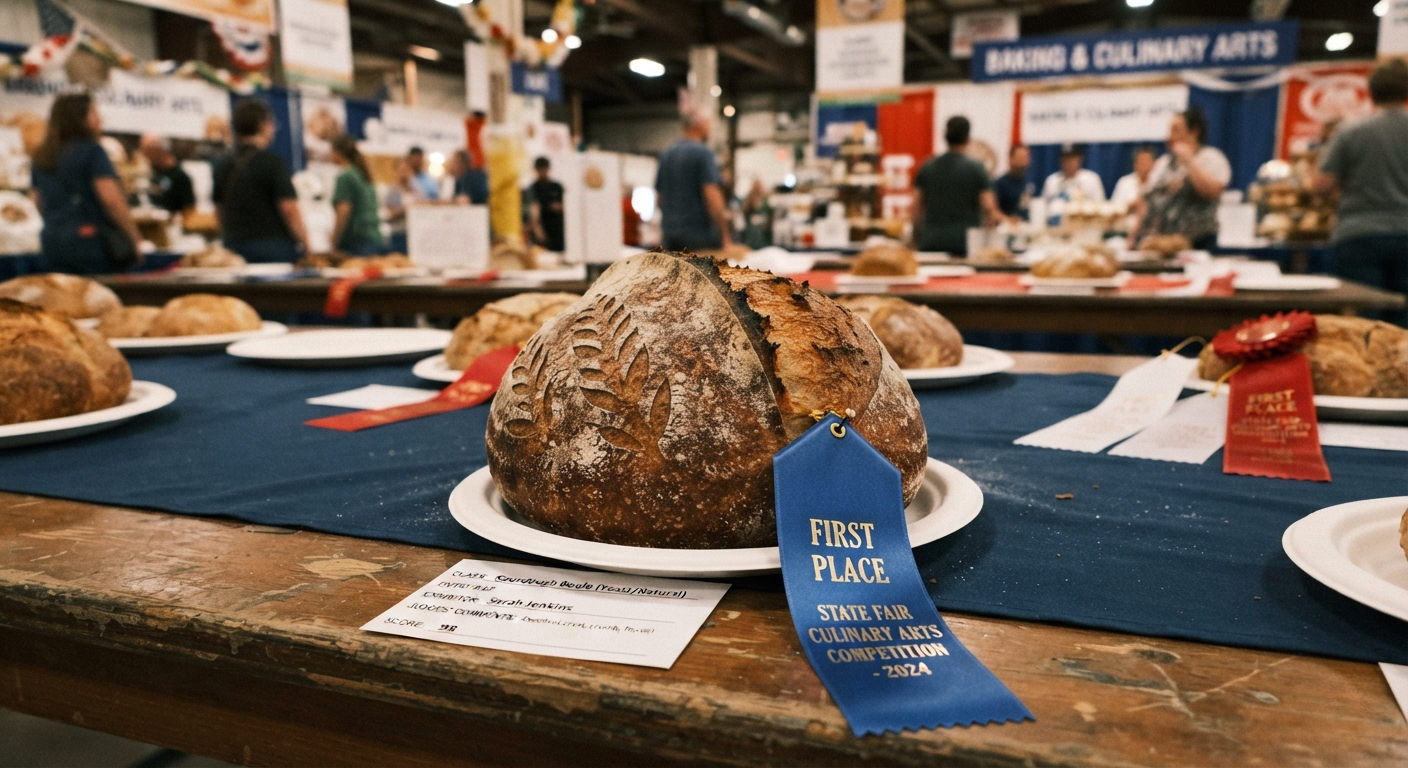
Your first state fair bread competition is won in the six weeks before take-in day, not on the morning you hand over the loaf. Here’s the timeline, the judging criteria, and the 2026 deadlines that are already closing.
By Henry Hunter · Updated August 7, 2026

The smell hits you first. You walk into that competition tent at 7 AM and you’re surrounded by dozens of fresh loaves cooling on folding tables. Bakers making last-minute adjustments, brushing crusts with oil, trimming an uneven edge with a paring knife. Your heart’s going because you’re about to put your bread up against people who have been doing this since before you owned a Dutch oven.
I remember my first entry like it was yesterday. Three weeks perfecting what I was sure was the perfect sourdough boule. Got there early, confident. Then I looked at the other entries on the table and understood that I had no idea what I was doing.
That was sixteen years ago. Since then I’ve judged competitions, mentored first-timers, and taken home my share of ribbons. What I learned is that the gap between a “nice try” loaf and a blue ribbon loaf is almost never talent. It’s preparation, and most of it happens weeks before you walk into the tent.
If you’re thinking about entering this year, here’s everything I wish someone had told me before that first nervous morning.
First, Check Your Calendar. The Deadlines Are Closer Than You Think
This is the part that catches people. Fair season feels like an October thing, so bakers wait until September to start thinking about it. By then registration is closed in half the country.
Two examples from my part of the world, both confirmed for 2026:
- South Carolina State Fair: entries close September 1, 2026. The fair itself runs October 15 through 25 under the theme “Rooted in Fun,” with more than $300,000 in premiums on the table. New this year is a Pro Kitchen “Rooted in Tradition” Bread Contest, which is worth a look if you bake something with a story behind it.
- North Carolina State Fair: registration opened July 1 and closes September 15, 2026. Mailed entries have to be received by October 5. Take-in is Saturday October 10 and Sunday October 11, 8 AM to 6 PM at the Education Building.
That means if you’re reading this the week it went up, you have roughly three and a half weeks for South Carolina and five for North Carolina. Enough time to prepare properly. Not enough time to procrastinate.
Whatever state you’re in, go find the premium book right now, before you read the rest of this. Not the fair’s homepage, the actual premium book PDF. That’s where the category numbers, the entry fees, the pan size requirements, and the residency rules live. North Carolina, for instance, is open to NC residents only and allows one entry per class per household. Every entry has to be from scratch, and commercially produced products are not accepted. Those rules vary by state and they are not negotiable at the take-in table.
Understanding What Judges Really Look For
Fair judges aren’t only tasting your bread. They’re reading your technique. Every competition I’ve judged uses roughly the same criteria, but here’s what those criteria actually mean when there are forty loaves on the table.
Appearance
Your bread gets about thirty seconds of visual evaluation before anyone picks up a knife. A uniform, golden-brown crust tells a judge you understand your oven. Clean shaping tells them you understand dough. I’ve watched technically excellent bread lose points to sloppy presentation, and it’s a miserable way to lose.
Crumb Structure
When we slice into your loaf, we’re looking for consistency. Giant random holes sitting next to dense patches tell a story of uneven fermentation or rushed shaping. Open crumb isn’t automatically better, by the way. An open, wild crumb in a sandwich bread category is a fault, not a flourish. The crumb should match the category.

Flavor
Judges taste dozens of loaves in one session, and palate fatigue is real. Your bread has to register without being a gimmick. Balanced flavor means every element earns its place. If you’re entering herb focaccia, those herbs should support the bread, not cover for weak fundamentals.
Texture
A proper crust should give way to a tender crumb without turning gummy. Sourdough judges look for that slight chew that only comes from real fermentation. Dense bread points to timing problems. A crust that’s gone soft usually means it was bagged before it finished cooling.
Choose Your Battle Wisely
This is not the moment to try the technique you saw on Instagram last Tuesday. Fair success comes from executing fundamentals cleanly.
Stick with your strengths. I tell everyone in the community the same thing: enter the bread you could make blindfolded. Your signature loaf. The one friends ask for by name. The recipe you’ve made fifty times and whose every mood you know.
Read the categories carefully. Most fairs split entries into white bread, whole wheat, sourdough, specialty or fancy breads, rolls, and quick breads. Entering a rustic, tangy, open-crumb sourdough in the white bread category isn’t bold, it’s just a scoring problem you created for yourself. Match the loaf to the class description word for word.
Plain versus flavored. Plain loaves let judges focus entirely on technique, which cuts both ways. Flavored breads can win a table, but they can also spotlight flaws you were hoping to hide. My advice: if your fundamentals are solid, go plain. If you’ve perfected a combination that’s genuinely yours, go flavored and commit to it.
I once watched a baker take first with a plain white sandwich loaf because the execution was flawless. Perfect crumb, even crust, square shoulders, clean slice. Sometimes mastery of the basics beats complexity outright.
Work Backward From Take-In Day
Here’s the thing nobody hands you: a calendar. Most first-timers plan forward from today, run out of runway, and end up baking their entry for the first and only time the night before. Plan backward instead.
Using North Carolina’s October 10 take-in as the anchor, here’s how the six weeks look:
- Week 1: Pull the premium book. Pick your category and your recipe. Register before the deadline, don’t wait.
- Week 2: Practice run one, the baseline. Make it exactly the way you always do and write down everything.
- Week 3: Practice run two, the simulation. Same wake-up time, same schedule, same transport container you’ll actually use.
- Week 4: Fix whatever run two exposed. Usually it’s timing, occasionally it’s the pan.
- Week 5: Practice run three, the dress rehearsal. This loaf should be competition-ready. If it isn’t, you found that out with a week to spare, which is the whole point.
- Week 6: Bake the entry the day before take-in. Cool it fully. Sleep.
Three practice runs is the floor, not the ceiling. But three is enough to know your loaf.


Perfecting Your Technique for Competition Day
Competition baking is different from home baking. Everything has to be a little more precise and a little more controlled, because you don’t get a second attempt.
Timing your proof. This is where most first-timers come apart. Your bread needs to hit the proofing window when you’re ready to bake it, not when it happens to be convenient. Work backward from the submission deadline and build the schedule around it.
Temperature control. Your oven behaves differently than the dial claims. Buy a thermometer and find out by how much. Mine runs 25 degrees hot, and I only learned that by testing. A lot of competition failures are really just an untested oven.
Cooling is technique, too. Don’t rush it. I’ve seen beautiful loaves ruined because somebody got impatient and sliced early. The crumb keeps setting as it cools, and a judge can spot a loaf that was cut too soon from across the room.
Start With a Culture You Can Trust
Let’s talk about the thing that quietly decides a lot of sourdough entries: your starter. I’ve watched excellent technique undone by a weak, moody culture that picked competition week to go sluggish.
That’s part of why I work with SourHouse. Their dehydrated starters are consistent and vigorous, and when you’re already nervous about fair day, taking one variable off the table is worth something. Their Goldie warming unit does the same job from the other direction by holding your starter in a steady temperature range instead of leaving it to the mercy of a September kitchen. Use code HBK26 for a discount.
If you’d rather work with the starter you already have, that’s fine, just start feeding it twice a day two weeks out. A starter that’s been on a neglect schedule since June will not perform on demand in October.
Competition Day Strategy
The morning of take-in, you want zero surprises.
Timing. Submit as close to the deadline as you can while leaving yourself real buffer. Fresh bread scores better than day-old bread, but rushed bread scores worst of all, and traffic near a fairground on take-in weekend is its own event.
Transport. I use a clean cardboard box lined with parchment, with the loaf sitting on a towel so it can’t slide. No sealed plastic containers, they trap condensation and soften the crust you worked for. No foil against the crust, it sticks.

Final check. Before you hand it over, look at it the way a judge will. Trim an uneven edge with a sharp knife if you need to. A light brush of oil can help the appearance. Don’t overdo it, a greasy loaf reads as a greasy loaf.
The Mental Game
Here’s what nobody mentions: the nerves are real. You’re handing something you made to strangers to be judged, and that’s a vulnerable thing to do.
I’ve watched talented bakers talk themselves out of it while walking the tent, looking at everyone else’s entries. Don’t do that to yourself. Your bread earned its place on that table because you made it with skill and care.
Win or lose, you’re standing in a room full of people who value the same craft you do. Some of my closest baking friendships started at a take-in table. The person setting up next to you might be the one you text at 11 PM about a stalled bulk ferment three years from now.
Beyond the Ribbon
Whether you take first place or nothing at all, you’ll leave with something useful. Most fairs send written judge feedback home with the entry. Read it more than once. If you can find the judge afterward, ask.
Some of my biggest jumps came from fair feedback. A judge once wrote that my sourdough was “technically proficient but lacked personality.” That stung, and it also changed the way I’ve approached flavor development ever since.

From the Competition Tent to the Market Stall
Here’s what tends to happen after a good fair. Somebody sees the ribbon, or tastes the loaf, and asks where they can buy it regularly. That question is how a lot of home bakers accidentally back into a business.
The technique that wins ribbons is the same technique that keeps market customers coming back. What’s missing is everything around it: what it actually costs you to make a loaf, what to charge, what your state’s cottage food law lets you sell and where, and how to build a Saturday production schedule that doesn’t wreck you. That’s the whole reason I built the From Oven to Market course, which walks through the legal setup, true cost pricing, insurance, and the first market table, step by step.
Consistent fair placings are a decent signal that the baking side is ready. The business side is a separate skill, and it’s learnable.
State Fair Bread Competition FAQ
When do state fair bread competition entries close?
Most state fairs close entries four to eight weeks before the fair opens, which usually lands in late August or September for an October fair. South Carolina closes September 1, 2026 and North Carolina closes September 15, 2026. Check your own fair’s premium book, because the date moves year to year.
What do judges look for in a fair bread competition?
Judges score appearance, crumb structure, flavor, and texture. Appearance means a uniform golden crust and clean shaping. Crumb means consistency that matches the category, not just big holes. Flavor should be balanced, and texture should show a crust that gives way to a tender interior without gumminess.
Should I enter plain bread or flavored bread at a state fair?
Plain loaves put all the attention on your technique, which rewards clean fundamentals and punishes small flaws. Flavored breads can stand out on a crowded table but can also highlight weaknesses. If your fundamentals are solid, go plain. If you’ve perfected a combination that’s truly yours, commit to it.
Make It Happen
Fair season is on. South Carolina closes September 1 and North Carolina closes September 15, and your state is probably somewhere in that same window. Don’t spend another year watching from the sidelines wondering whether your bread is good enough.
It is.
Pick your recipe. Pull the premium book. Put the three practice bakes on the calendar. This could be the year you surprise yourself.
If you want company while you prepare, come bake with us in Crust & Crumb Academy. There are bakers in there who compete every fall and they’ll tell you exactly what their state’s judges look for.
Have you competed before, or is this your first year thinking about it? Tell me in the community. We’re all pulling for each other.
About Henry Hunter

My name is Henry
I teach people how to bake great bread at home, without the intimidation or gatekeeping that makes bread seem harder than it is. I also teach home bakers how to turn that skill into a real business, from understanding their costs and pricing their products to finding customers and selling at market.
At the center of both is the same idea: give people practical knowledge, the right tools, and the confidence to do something they didn’t think they could do. fromoventomarket.com
Thinking Past the Ribbon
From Oven to Market
Cottage food law, true cost pricing, insurance, labeling, and your first market table. The business side of baking, one step at a time.
See the Course
Keep Baking With Me
Bakers come here not to get likes, but to get better.

Leave a Reply