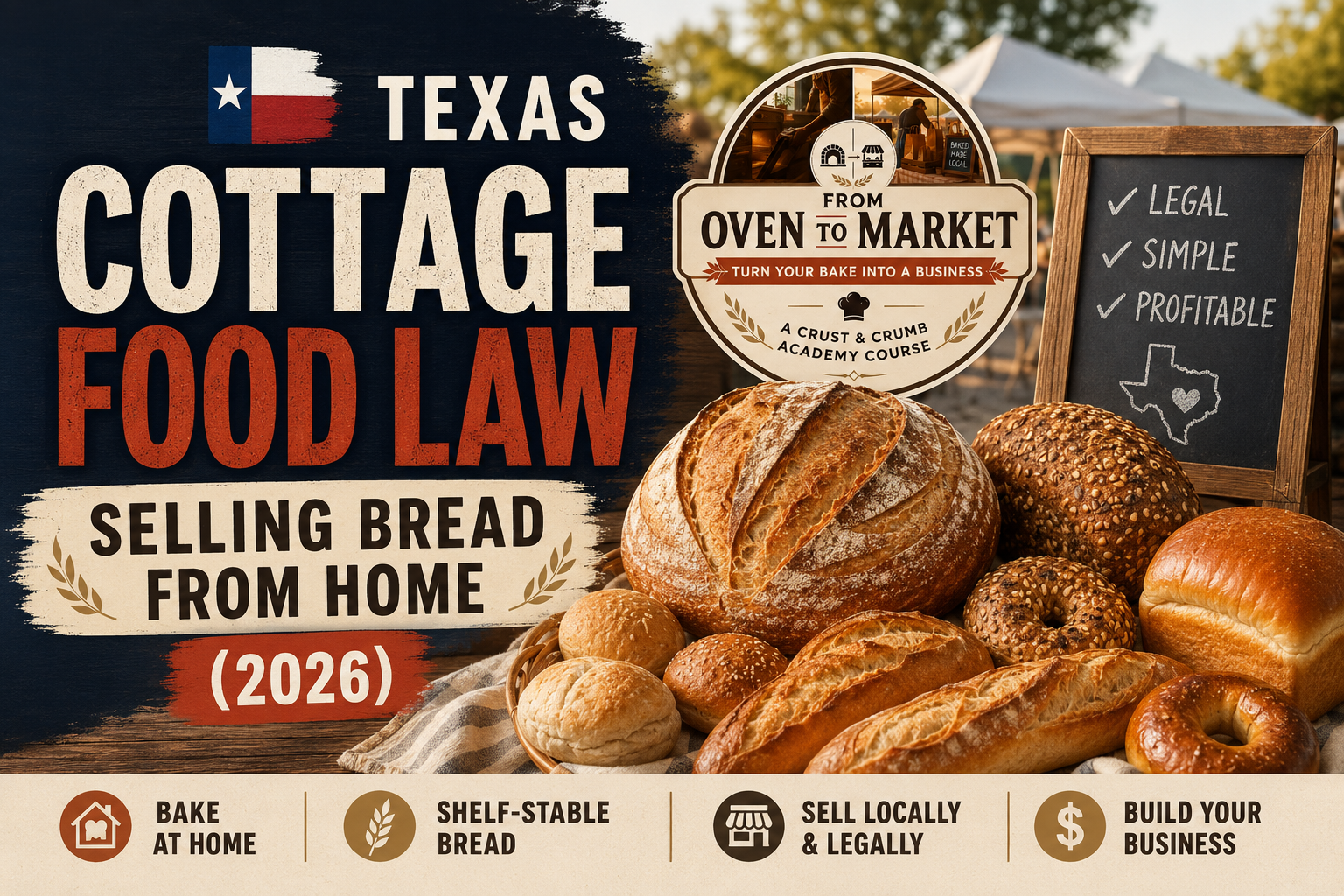
Texas just became one of the best states in the country for selling homemade bread. Here’s how the Texas cottage food law works in 2026.
By Henry Hunter · Updated June 2026

Texas lets you sell bread from your home kitchen with no permit, no license, and no inspection. You’ll need a cheap food handler card and a correctly worded label, and you can sell up to $150,000 a year, a cap that tripled in September 2025. Sales have to stay inside Texas and go to your customer directly. That’s the short version. The details are below, and since laws keep moving, confirm the current rules with Texas DSHS before you start.
Do you need a license to sell bread in Texas?
No license, no permit, no inspection. A cottage food production operation in Texas doesn’t need anything from the health department to exist, and local governments can’t regulate you out of your kitchen. There’s one requirement instead: a food handler card. You take an accredited basic food safety course, about two hours online, usually $10 to $15, and the certificate is good for two years.
Anyone in your household who helps produce the bread should hold one too. Texas also offers an optional, free registration with DSHS that gives you a unique ID number you can print on your labels instead of your home address, a nice option if you’d rather not hand out where you live with every loaf.
Is there a sales limit?
Yes, but it’s a generous one: $150,000 per household per year. That’s the new number from Senate Bill 541, which took effect September 1, 2025 and tripled the old $50,000 cap in the Texas cottage food law. The cap is also set to adjust with inflation going forward. For perspective, at $10 a loaf you’d need to sell about 290 loaves a week, every week, to hit it. I was proud of my 80 to 90 loaves a Saturday. Texas gives you room to triple that and keep going.
What bread qualifies under the Texas cottage food law
Baked goods are the heart of the Texas cottage food list, and bread sits squarely inside it. Sourdough, sandwich loaves, rolls, bagels, focaccia, baguettes, biscuits, tortillas: all clear, because they’re shelf-stable and don’t need refrigeration to stay safe. The line shows up at fillings and frostings that need the fridge, think custard, fresh cream, or cream cheese. Texas has even opened the door to some refrigerated foods under extra rules, but for a bread baker the simple path is the best one: if it sits happily on the counter for days, you’re in business.


Thinking about selling your bread? Take the Free 60-second Bread Business Quiz and find out where you are on the journey from home baker to market baker.
The label Texas requires
Every product needs a label with your operation’s name and your home address, or your DSHS ID number if you registered, the common name of the product, and a clear statement of any major allergens inside: wheat, milk, eggs, soy, tree nuts, peanuts, fish, shellfish, and sesame. Bread bakers, wheat is on almost every label you’ll print. Texas also requires this exact statement on every label:
THIS PRODUCT WAS PRODUCED IN A PRIVATE RESIDENCE THAT IS NOT SUBJECT TO GOVERNMENTAL LICENSING OR INSPECTION.
Copy it word for word. Adding a full ingredient list in descending order isn’t a bad habit either, customers ask, and it builds trust at the table. One more note: if you ever sell refrigerated goods or sell wholesale under the new rules, the production date goes on the label too.
Where Texans can sell
Almost anywhere, as long as the sale is direct to the person who’ll eat your bread and stays inside Texas. Farmers markets, farm stands, roadside stands, fairs, festivals, your front porch: all fine. Online orders are fine too, with one Texas-sized catch. You, an employee, or a member of your household has to personally deliver the bread to the customer. No USPS, no UPS, no FedEx. Shipping is off the table, and so is selling to customers outside Texas.
The 2025 law also added something rare: a cottage baker can now sell wholesale to a registered Texas cottage food vendor, who can then resell your bread at markets, stands, and stores. Most states don’t allow anything like that. When you’re ready for your first table, here’s how to sell bread at farmers markets.
Your Texas starting point
Four steps. Take your food handler course this week, it’s two hours. Read the official rules on the Texas DSHS cottage food page, and bookmark texascottagefoodlaw.com, a baker-run resource that tracks every change. Build your label and print twenty of them. Then pick your first market date and put it on the calendar. The legal setup in Texas takes a weekend. Turning it into sold-out Saturdays is the part I walk you through inside From Oven to Market.

If you’ve started wondering whether the bread you bake could actually pay for itself, that’s the whole reason I built this course. From Oven to Market walks you through the legal setup, the true cost of a loaf, pricing, and getting to your first market table, in the order I wish someone had handed me years ago. You can see how it all fits together over at From Oven to Market.
Ready to take your baking further?

Reading about bread is one thing. Baking it alongside people who get it is another. That’s what we do inside Crust & Crumb Academy. Every Saturday we bake the same loaf together, share photos, troubleshoot in real time, and cheer each other on. Whether you’re shaping your first boule or chasing the perfect crumb, you’ll have a whole room of bakers in your corner.
Come bake with us 👉 Join Crust & Crumb Academy
Leave a Reply