
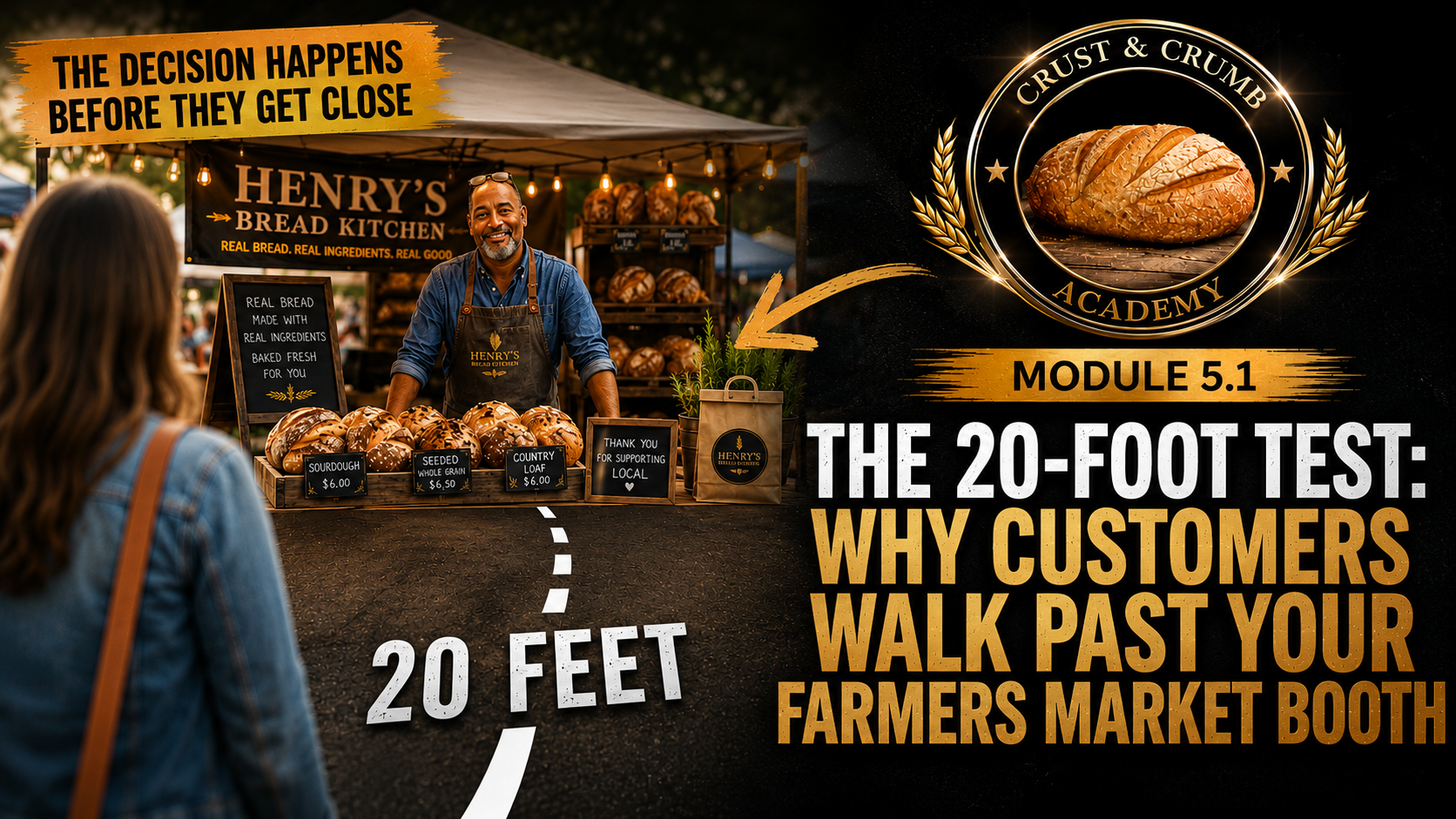
A customer decides whether to walk toward your farmers market booth display from about twenty feet away, before they read a single sign. Here’s how to pass that test, so the people already at the market actually make their way to your table.

The decision happens before they get close
Here’s something most market bakers never stop to think about. The sale isn’t won at your table. It’s won twenty feet away, while the customer is still walking.
Picture a busy market. Thirty booths, maybe more. A shopper walks the main aisle in about ninety seconds, and in that time their eyes are sorting every stall into one of two piles: worth a look, or keep moving.
They aren’t reading your sign yet. They can’t. They’re too far out. They’re reacting to the shape of the whole table, the color, whether anything pulls the eye. That snap judgment takes about half a second, and you don’t get a vote.
I call it the twenty-foot test, and your booth either passes it or it doesn’t. A flat farmers market booth display at waist level, no height, no focal point, reads as nothing from across the lot. The bread might be the best in the county. Doesn’t matter. If the booth doesn’t earn the stop, nobody ever gets close enough to find out.
What your booth says in half a second
When a stranger glances at your stall, their brain runs three questions before they’ve made a conscious decision about anything. You want clean answers to all three, fast.
What do they sell?
This is category filing. Bread? Pastries? Jam? Soap? If the eye can’t sort you in a beat, the brain files you under “mystery” and the feet keep walking. People don’t stop to solve a puzzle. Make the answer obvious from a distance, with the product itself doing the talking.
Who are they?
Hobby or business. This one’s quiet but it’s real. A bare folding table reads as somebody clearing out their kitchen. A booth with a name on it reads as a business that’ll be here next week too. A name creates an entity, and an entity earns trust. That trust is what lets you charge what your bread is worth.
What’s the price feeling?
Call it vibe calibration. Before they ask the price, people decide what they expect to pay, based purely on how the booth looks. If the aesthetic says six dollars and your sign says twelve, that gap creates friction, and friction loses sales. When the look and the price agree, the number feels fair before it’s even spoken.
The three things that pull people in
Pass the twenty-foot test and you’ve covered three jobs: a clear sign, a visual hierarchy, and a consistent color story. Get these right and a stranger reads your whole farmers market booth display in one glance.

A clear sign
Your sign has one job: be legible from twenty feet, with your real business name on it. Not a scrap of paper taped to the tablecloth. A sign that names the business turns a table of loaves into “Henry’s Bread Kitchen,” and that creates an immediate identity. People remember a name. They can’t remember “that one bread table.”
Visual hierarchy
Three rules here, and they stack. First, the product is the hero. Not your tent, not your banner, the bread. Second, break the flat plane. A table where everything sits at the same height reads as flat and dead from a distance.
Third, build vertical abundance. Use crates, risers, tiered shelves to lift loaves to different heights so the display climbs toward eye level. Height reads as abundance, and abundance pulls people in. A tall, full-looking booth says “this baker is doing well, the bread must be good.”

A consistent color story
Pick two or three colors and stop there. A tablecloth, a sign, a banner, all pulling in the same direction. More than three and the booth turns to visual noise, and noise makes the eye bounce off instead of landing. A tight palette eliminates that noise and tells the eye exactly where to go. It also reads as intentional, which loops right back to “this is a real business.”
The friction points, and the fixes
Most farmers market booth displays fail the twenty-foot test for the same handful of reasons. Here’s what trips people up and the simple fix for each.
| Friction point | The fix |
|---|---|
| Flat plane, everything at one height | Vertical tiers with crates and risers |
| Buried or missing business name | An eye-level banner with your real name |
| Visual clutter, too much going on | Edit down to the essentials |
| Mismatched colors fighting each other | A three-color maximum palette |
None of these cost much. They’re mostly about subtraction and arrangement, not spending.
The neighbor effect
Here’s the part bakers miss. You’re not just competing with the other bread sellers. You’re competing with every booth in the aisle for the same pair of eyes. The flower stand, the candle maker, the woman with the beautiful jam display. The best-styled booth in the row sets the bar, and your table gets judged against it whether you like it or not.
That’s not bad news. It means a clean, intentional farmers market booth display stands out even in a crowded market, because most stalls never think this through. A little effort here goes a long way, since the baseline is low.
The smartphone audit: your action step
You don’t need a designer to fix your farmers market booth display. You need your phone and twenty feet of distance.
Stand back from your own table and take a photo of it, framed the way a stranger would see it walking up. A photo flattens your visual field into two dimensions, the same way a glance does.
Then look at the picture and be honest. What does your eye land on first? Can you read the name? Does it look like one business or a yard sale? Whatever disappears in the frame is exactly what the customer misses in real life.
Then write down the three changes that would do the most work. Usually it’s height, a real sign, and cutting clutter. You can fix all three before your next market for almost nothing. If you want a structured way to score it, the From Oven to Market Booth Audit Worksheet walks you through it one honest pass at a time, the same checklist I use.
The booth earns the stop. The product earns the return.
That’s the whole idea in one line. Your booth does the first job, getting a stranger to walk over. Your bread does the second, making them come back next Saturday. Neither one carries the other. Build the booth that passes the twenty-foot test, and you put your bread in front of the people who came to the farmers market ready to buy it.
This is exactly the kind of thing we work through together inside From Oven to Market, the whole system for selling your bread, not just baking it. And if you’re still building your lineup, there’s a vault of tested recipes waiting in the free Recipe Pantry.
Frequently asked questions
How do customers decide which farmers market booth to visit?
They decide from about twenty feet away, in roughly half a second, before they read any signs. Their eye reacts to the booth’s height, color, and focal point and sorts it into “worth a look” or “keep moving.” A flat, low table with no clear name rarely earns the stop.
What makes a farmers market booth stand out?
Three things working together: a clear sign with your real business name, a visual hierarchy that lifts product to different heights instead of one flat plane, and a consistent two or three color palette. Together they read as a real, trustworthy business in one glance, which is what separates a strong farmers market booth display from a forgettable one.
How do I set up a farmers market booth display on a budget?
Most of the work is free. Use crates and boxes you already own to build height, make one clear sign with your business name, cut anything that adds clutter, and keep your colors to three or fewer. The fixes are mostly arrangement and subtraction, not spending, so almost any farmers market booth display can pass the test on a tight budget.
Why do customers walk past my booth even though my bread is good?
Because the bread never gets a chance. If the booth fails the twenty-foot test, the customer keeps walking before they’re close enough to judge the product. The booth earns the stop, then the bread earns the return. You need both.
How can I tell what my farmers market booth looks like to a customer?
Stand twenty feet back and take a photo. The photo flattens your booth into two dimensions the way a passing glance does. Whatever disappears in the frame, your name, your focal point, is what the customer misses too. Then fix the three biggest gaps.
You got them to walk over. Next, we make your packaging do the work after the sale, when your loaf is sitting on a kitchen counter for four days telling your story for you.
Perfection is not required. Progress is.

Your first market morning is going to feel like a lot, and that’s normal. If you want a steadier start, how to sell the bread you bake is exactly what the course is built around, from booth setup to selling out before noon. I’d rather you walk in ready than learn it the hard way like I did.
Ready to take your baking further?

Reading about bread is one thing. Baking it alongside people who get it is another. That’s what we do inside Crust & Crumb Academy. Every Saturday we bake the same loaf together, share photos, troubleshoot in real time, and cheer each other on. Whether you’re shaping your first boule or chasing the perfect crumb, you’ll have a whole room of bakers in your corner.
Come bake with us 👉 Join Crust & Crumb Academy
Leave a Reply