Can You Legally Sell Bread From Home?

Henry Hunter
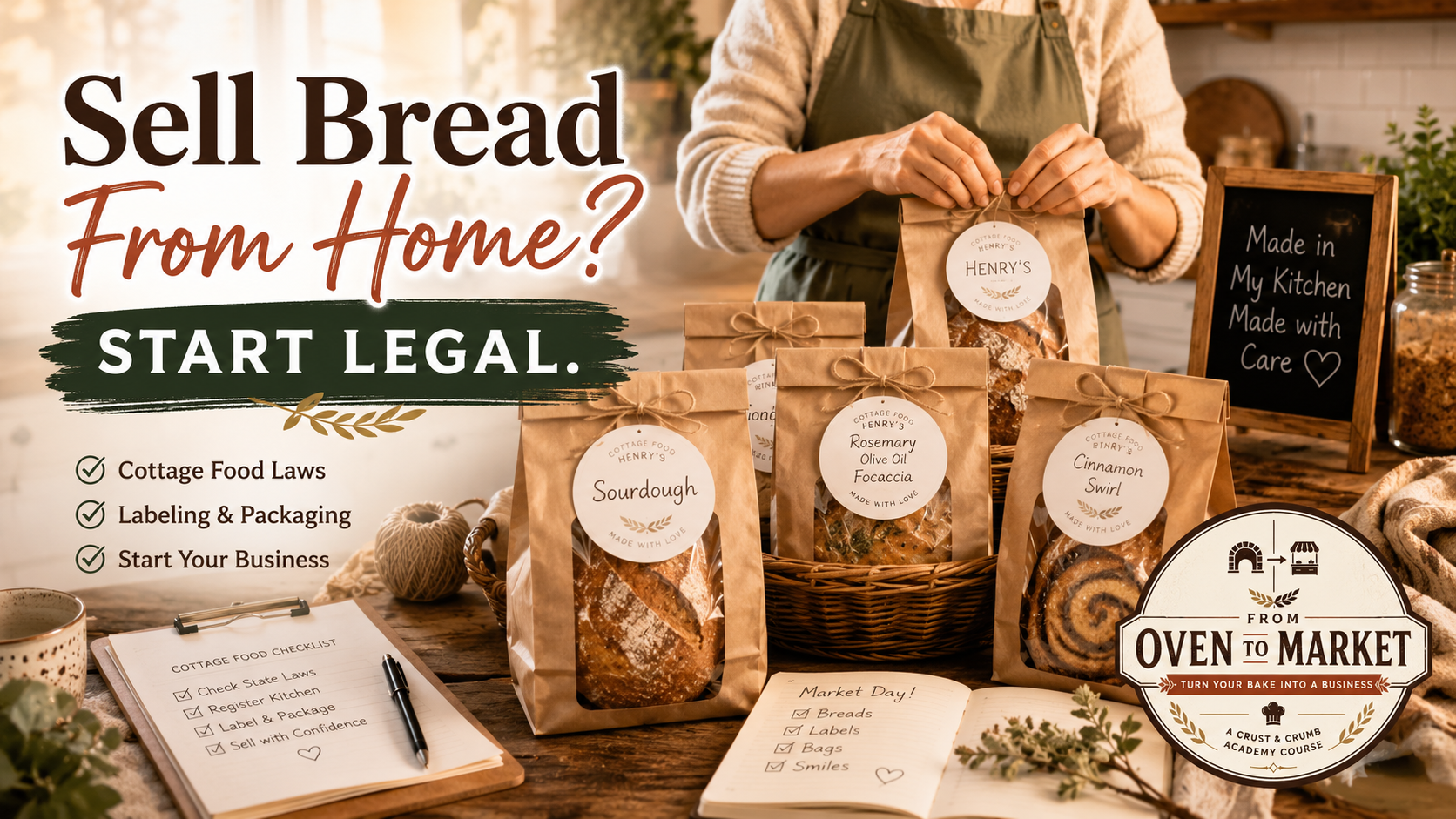
Packaged homemade bread loaves on a kitchen table with cottage food labels, a checklist, and a From Oven to Market course badge, illustrating how to legally sell bread from home.

Can You Legally Sell Bread From Home?

Short answer: in most states, yes, you can sell bread from home, as long as you follow your state’s cottage food laws. Here’s the honest version of what that means.

By Henry Hunter · Baking Great Bread at Home

Loaves of homemade bread bagged and labeled on a kitchen counter, ready to sell bread from home legally under cottage food laws.
Plain bread is shelf-stable and low-risk, which is why it’s one of the most commonly allowed cottage foods in the country.

It’s the question I hear most from bakers who are good enough to sell and just scared of the legal side. Can you actually sell the bread you bake out of your own kitchen, or do you need a commercial space and a pile of permits first?

For most people in most states, the answer is yes. The thing that makes it legal is called a cottage food law, and nearly every state has one. What changes, and changes a lot, is the details. So let’s walk through what’s real, what to watch for, and how to find the rules where you actually live.

• • •

What a cottage food law actually is

A cottage food law is the rule that lets you make certain foods in your home kitchen and sell them to the public, without renting a commercial kitchen. Bread is one of the most commonly allowed cottage foods in the country, because plain bread is shelf-stable and low-risk. That’s good news for you.

The catch is that these laws were written state by state, so no two are identical. Some states let you start with nothing more than a label. Others want you to register, take a food handler’s course, or pass a kitchen inspection. A few cap how much you’re allowed to earn in a year. None of that should scare you off. It just means you have to know your own state’s version before you set up a table.

The rules you’ll run into almost everywhere

Even though the specifics differ, the same handful of issues come up in nearly every state. If you understand these five, you’ll know what questions to ask.

1. Registration or a permit. Some states let you sell with no paperwork at all. Others want you to register as a cottage food operation, get a business license, or pull a temporary food permit for each market you sell at. This is the first thing to check.

2. What you’re allowed to bake. Cottage food rules separate foods by risk. Plain bread, rolls, and most sourdough are almost always fine because they don’t need refrigeration. The trouble starts with anything that has to stay cold. Not sure what to put on your table? Here are the 10 best breads to sell at farmers markets.

3. The refrigeration line. This one trips up a lot of bakers. Many states restrict or flat out ban selling things like banana bread and zucchini bread under cottage food rules, because the moisture and add-ins can push them into “needs refrigeration” territory. Same goes for anything with a cream filling or a perishable frosting. Check before you build a menu around quick breads.

4. Labeling. Almost every state wants the same basic information on your label: the product name, your business name and address, the ingredients listed by weight, the net weight, allergen callouts, and a statement that the food was made in a home kitchen that isn’t subject to state inspection. The exact wording of that home-kitchen line is set by your state, so use theirs, not a version you found online.

5. Where and how you can sell. Most cottage food laws cover direct sales: farmers markets, roadside stands, your own pickup. Selling to stores, restaurants, or across state lines usually falls under different, stricter rules. Start with direct sales and grow from there.

A cottage food label on a bagged loaf of homemade bread showing product name, ingredients, and the home-kitchen statement.
Almost every state wants the same fields on your label, but the home-kitchen disclosure line is the one your state words for you.

Insurance, even when it’s not required

Some markets won’t let you set up without liability insurance, and even where it’s optional, it’s cheap peace of mind. For a small home baking or cottage food business in the US, general or product liability coverage often runs roughly $25 to $65 a month, or about $300 to $800 a year, depending on your state, your revenue, and the limits you carry. A product liability policy protects you if someone ever claims they got sick from something you sold. Treat it as part of doing this like a business, not a hobby.

A home baker's bread table at a farmers market with labeled loaves stacked and priced for direct sale.
Most cottage food laws are built for direct sales like this, so start at a market or a stand and grow from there.

How to find your state’s actual rules

This is the part that matters most, because I can tell you the categories, but I can’t tell you your state’s numbers. Here’s how to get the real answer fast.

Start with a national directory. The cottage food directory at Forrager keeps a plain-English summary for every state: what’s allowed, whether you need to register, sales limits, and labeling rules. It’s the quickest way to see where your state stands before you call anyone.

Then go to the source. Your state’s department of agriculture or department of health is the agency that actually writes and enforces these rules. Search for your state’s name plus “cottage food law” and look for the .gov result. Where I started out, in South Carolina, it’s the Department of Health and Environmental Control. Yours will have its own agency. Find it, read the rules, and stick to them.

Then ask your market. Market managers deal with vendor permits every weekend. Once you know your state rules, a five-minute call to the market you want to sell at will tell you exactly what they require at the table.

Complying with the rules isn’t just about staying out of trouble. It builds trust with your customers and with the market organizers, and that trust is what keeps you coming back week after week. It’s the foundation everything else sits on.

Want to know you’ve got the legal part right before you sell your first loaf?

The legal setup is the whole first stretch of From Oven to Market, my step-by-step course on turning your baking into a real cottage food business. It walks you through finding your state’s rules, building a compliant label, getting insured, and pricing your bread so the work actually pays. Nine modules, from your home kitchen to a table at the market.

See what’s inside the course →

So, can you sell bread from home? Probably yes.

If you’ve been holding back because you assumed it was complicated or illegal, here’s the truth. In most of the country, selling bread from home is one of the most accessible small businesses there is, precisely because bread is low-risk and cottage food laws were built for exactly this. The work isn’t getting permission. The work is doing it right: knowing your rules, labeling clean, and pricing like you mean it.

Find your state’s rules this week. Then bake a test batch, label it properly, and take it to one market. You’ll learn more from one Saturday at a table than from a month of worrying about it.

If you’d rather have the whole roadmap in order instead of figuring it out piece by piece, that’s exactly what I built From Oven to Market to give you. And if you just want to bake alongside other people doing the same thing, come join us free in Crust & Crumb Academy.

Perfection is not required. Progress is.

Do I need a license to sell bread from home?

It depends on your state. Some states let you sell bread from home with no license at all. Others want you to register as a cottage food operation, pull a permit, or take a short food handler’s course first. Bread is low-risk, so the bar is usually low, but check your own state’s cottage food rules before your first sale.

Can I sell banana bread under cottage food laws?

Often not the same way you can sell plain bread. Many states treat banana bread and zucchini bread as needing refrigeration because of their moisture, which can put them outside basic cottage food rules. Plain breads and most sourdough are almost always allowed. Check your state before you build a menu around quick breads.

Where can I sell?

Most cottage food laws cover direct sales: farmers markets, roadside stands, and your own pickup or delivery. Selling to grocery stores, restaurants, or across state lines usually falls under stricter rules. Start with direct sales, then confirm what your specific market asks of vendors.

Keep Baking With Me

🎓 Join Crust & Crumb Academy — Free
1,000+ bakers · 32 courses · Saturday Bake-Along every week · #1 ProveWorth Certified community on Skool. Come bake with us.
★★★★★ 5.0 from 61 verified bakers
ProveWorth Certified · Top 1% of all Skool communities · 100% recommend rate
▶️ Become a YouTube Member
🌾 The Starter $2.99/mo · 🥖 The Apprentice Baker $9.99/mo · Loyalty badges + members-only chats (join via web browser for best price)
📒 The Recipe Pantry
130+ tested recipes with built-in timers, baker’s math scaling, and the Krusty AI baking assistant.
✉️ The Saturday Recap Newsletter
One email a week. Recipes, tips, and the week’s bakes.

Bakers come here not to get likes, but to get better.

Discover more from Baking Great Bread at Home Blog

Subscribe now to keep reading and get access to the full archive.

Continue reading

Verified by MonsterInsights