
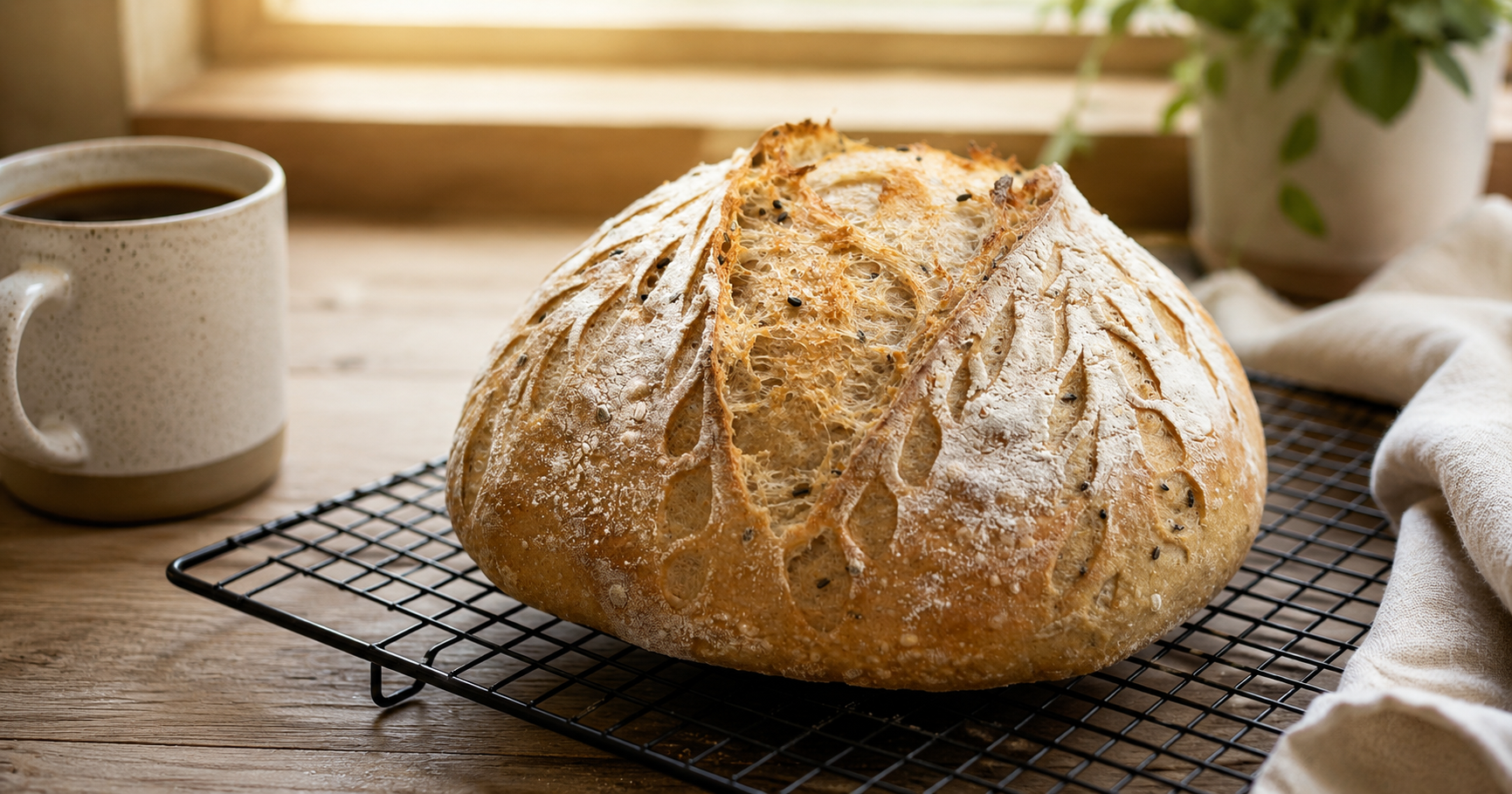
The complete guide to a sourdough baking schedule that fits a busy working life. It covers equipment, starter care, mindset, and the long view. Written by Henry Hunter, founder of Crust & Crumb Academy.
What’s in this post
- Before You Read This
- The 16-Hour Myth
- The Working Baker’s Week
- The Long View: Year 1, Year 5, Year 10
- Why I Tell Working Bakers Not to Bake on Weeknights
- The Minimum Kit a Working Baker Actually Needs
- The Mental Game (Where Most Bakers Actually Quit)
- Starter Care Without the Anxiety
- Bake Day, Streamlined
- Your Next Step This Week
- For Everyone, No Matter Where You Are
- The Last Thing
Before You Read This
I want to tell you something before we get into schedules and equipment and starter care.
I wasn’t always a baker. I learned bread baking decades ago as a young soldier stationed in a small village in Germany called Schwabisch Gmund. My landlord was a stout Jewish baker named Herr Sherman, and he had a habit of dragging me down to his shop. “This will help keep your rent low,” he’d say. So I helped.
The shop was always full of beautifully braided challah loaves that disappeared by Friday afternoon. I asked him why so much attention to this one bread. He invited me to help, and as we worked, he taught me that challah is a symbol of tradition and faith, that the braids represent love, unity, and the intertwining of our lives with our community. He taught me the ritual of hafrashat challah, a mitzvah where a small piece of dough is wrapped in foil and tossed in the back of the oven as an offering. To this day, every time I bake, I do the same thing.
Then I left the military. I went into the corporate world. I worked in marketing and advertising at CBS and Fox for 26 years.
And I stopped baking.
Not because I lost interest. Because life filled up. Children. Baseball. Soccer. Gymnastics. Ballet. A wife building a dental practice. A career that ran on its own clock. There was no time for bread, and honestly, I didn’t even think about it. The kitchen Herr Sherman taught me about was a memory I’d packed away with everything else from another life.
Then one day at the TV station, they were doing construction. I stepped off the sidewalk into a hole and tore up my knee, my shoulder, and my back. The injury forced me to slow down. And during the recovery, somewhere in the middle of being unable to do the things I’d been doing for 26 years, I baked a loaf of bread.
Everything came back.
I tell you this because if you’re reading this post, you’re probably in some version of that story. You have a job. You have a life. Maybe you have kids in soccer or a partner who works late or a calendar that’s already too full. And you’ve been told that sourdough takes too much time, requires too much attention, demands too much of a schedule you don’t have.
I’m here to tell you that’s not true.
Bread will wait. It always waits. And if you’ve ever felt like life is too busy for the things that matter to you, this post is for you.

Let’s get into it.
The 16-Hour Myth
The single biggest reason working people think they can’t bake sourdough is the math, and the math is wrong.
Someone reads that a sourdough loaf takes 16 hours from start to finish, and they hear “16 hours of work.” They picture themselves chained to the kitchen for two full days. They calculate that against their actual life and decide it’s impossible.
Here’s what’s actually happening in those 16 hours.
You feed your starter. 10 minutes of work. Then you go about your life for 8 to 12 hours.
You mix your dough. 10 minutes of work. Then you wait 30 minutes while you do anything else.
You do a coil fold. 2 minutes of work. Then you wait another 30 minutes.
You do another coil fold. 2 minutes of work. Wait again.
You shape the loaf. 10 minutes of work. Then you put it in the fridge and go to bed.
In the morning, you preheat the oven, score the dough, and bake. 15 minutes of active work, then an hour of being in the same room while it bakes.
Total hands-on time across the entire 16 hours: about 90 minutes, spread out in 5 to 10 minute chunks over a day or two.
That’s the real math. The 16 hours isn’t work. It’s fermentation. The dough is doing the work. You’re just nearby.
Once you understand the fundamentals, what you thought was 16 hours becomes maybe an hour and a half of actual hands-on time. The rest is the dough doing what dough has done for thousands of years.
If you can fit 90 minutes of small actions across a Friday evening and a Saturday morning, you can bake sourdough. Most working people can. They just don’t know it yet because nobody’s broken down the math for them honestly.
The Working Baker’s Week
Let me walk you through what a real working person’s sourdough week actually looks like, the way I’d coach a member through it on a Tuesday DM.
You work Monday through Friday, 9-to-5. You want one loaf on the table Saturday or Sunday. Here’s the week.
Monday through Wednesday: Your Starter Naps
Keep your starter in the fridge. Don’t touch it. It doesn’t need you yet.
This is the part most beginners get wrong. They feed their starter every day “just in case.” That’s wasted flour, wasted time, and it actually weakens the culture over time. Let it sleep. A healthy starter handles a week in the fridge without breaking a sweat.
Thursday Evening: Wake It Up
Get home from work. Change clothes. Pour a glass of wine if that’s your thing. Pull the starter out of the fridge.
Take a tablespoon of starter (about 15g), put it in a clean jar, and feed it 30g flour and 30g water. That’s a 1:2:2 ratio. Stir, cover loosely, leave it on the counter.
Total time: 5 minutes. You’re done for the night.
Friday Morning Before Work: Second Feed
Before you leave the house, that starter should be bubbly and risen. Discard most of it (compost or save for discard recipes), keep about 15g in the jar, feed it 60g flour and 60g water. That’s a 1:4:4 ratio, which gives it the runway to peak slowly while you’re at work.
Total time: 3 minutes. Out the door.
Friday Evening: Build Your Levain and Plan
You get home around 5:30 or 6 PM. Your starter is at peak or just past, doing its job. Now you build your levain for tomorrow’s bake.
Around 7 PM, take 30g of that active starter and feed it with 75g flour and 75g water. This is your levain. Cover it, leave it on the counter overnight. By tomorrow morning (around 7 AM) it’ll be ready to mix.
Total time: 5 minutes.
Honest advice: don’t try to do too much on Friday night. You’re tired. Mistakes happen when you’re tired. Just build the levain and go to bed.
Saturday Morning: Bake Day
7 AM. Coffee. Walk into the kitchen. Your levain is alive, doubled, domed, ready.
- 7:30 AM: Mix your dough. Combine the levain, flour, and water (fermentolyse). Rest 1 hour.
- 8:30 AM: Add the salt. Pinch and fold for 2 to 3 minutes.
- 9:00 AM: First coil fold.
- 9:30 AM: Second coil fold. If you’re doing inclusions like seeds or cheese, this is when they go in.
- 10:00 AM: Third coil fold.
- 10:30 AM to 1 PM: Bulk fermentation finishes. Look for 50 to 75% rise, domed top, side bubbles. Watch the dough, not the clock.
Between folds you can do whatever you want. Make breakfast. Read. Take a walk. The dough doesn’t need you for those 30-minute rest periods.
- 1:00 PM: Pre-shape on a lightly floured counter. Bench rest 20 to 30 minutes.
- 1:30 PM: Final shape. Into a heavily floured banneton, seam-side up. Cover with a bag or shower cap.

Saturday Afternoon: Choose Your Finish
Two options. Both work.
Option 1: Bake Saturday night. Let the dough proof at room temperature for 1 to 1.5 hours after shaping, then bake around 3 to 4 PM. Eat fresh bread with dinner. Total active time today: maybe 90 minutes spread across the day.
Option 2: Bake Sunday morning. Put the shaped dough straight in the fridge for an overnight cold retard. Pull it out Sunday morning, preheat the oven, and bake fresh for breakfast. Better flavor, easier scoring, and you walk into Sunday with bread in your house.
I lean Option 2 for most working bakers. The cold retard gives you flexibility, and Sunday morning bread is one of life’s small luxuries.
Sunday Morning (Option 2): The Payoff
- 8 AM: Start preheating your Dutch oven at 500°F. Full hour.
- 9 AM: Pull the dough straight from the fridge. Tip it onto parchment. Score it. Drop it in the hot pot.
- 9:00 to 9:30: Bake covered.
- 9:30 to 9:50: Bake uncovered until internal temp hits 205 to 210°F.
- 10:00 AM: Out of the oven. Onto a wire rack. Wait at least an hour before cutting.
- 11:00 AM: Real coffee. Real butter. Real bread. You did this.
Total active time for the whole week: about 2 hours.
Most of that is on Saturday morning, and most of Saturday morning is waiting between coil folds. You’re not chained to the kitchen. You’re just nearby.
No spam. One email when something matters.
The Long View: What Sourdough Looks Like at Year 1, Year 5, and Year 10
Most of what gets written about sourdough is about the next loaf. The next technique. The next recipe. Almost nothing gets written about what this craft looks like ten years in, when the urgency falls away and you’re left with what’s actually here.
Let me try to give you the long view.
Year One: The Year of Trying
You’re excited, you’re overwhelmed, you’re reading everything. Your starter has a name. You feed it more than it needs. You bake too often at first and then not enough when life gets busy. You have one or two breakthrough loaves that make you feel like a genius, and ten that make you feel like an impostor.
You compare yourself to everyone. You read recipes like scripture and feel guilty when you deviate. You buy equipment you don’t need. You ask the same question three different ways in three different forums hoping someone will give you the magic answer.
Most bakers quit somewhere in year one, usually month four or five. The ones who don’t quit are the ones who find a rhythm that fits their actual life. They stop trying to bake like a professional and start baking like themselves.
Years Two and Three
Your hands know things your head doesn’t. You can pick up a dough and tell, by feel, whether it’s under-developed or just right.
You stop reading every recipe before mixing. You start glancing at it for the ratios and doing it your own way. You realize most recipes are just suggestions written by someone who baked it once or twice in their kitchen. Your kitchen is different. Your flour is different. Your hands are different.
You start subtracting instead of adding. Fewer tools. Fewer steps. Fewer worries. The bake itself gets simpler even though the bread gets better.
This is also when you stop comparing your bread to other people’s bread. Your crumb has its own character. Your crust has its own color. Your flavor profile is yours.
Years Four and Five
Sourdough stops being something you’re learning. It becomes something you do. Like driving a car. You don’t think about the mechanics anymore. You just go where you’re going.
You start developing real opinions. Earned ones. You know what flours you prefer and why. You know what hydration ranges feel right to you. You stop chasing what’s popular and start trusting what works in your hands.
You start to understand the seasons. Summer dough behaves differently than winter dough. The flour from the harvest you bought in September isn’t quite the same as the flour you’ll buy next May.
Year Ten and Beyond
This is where the craft becomes something else entirely.
You’re not baking to learn. You’re not baking to prove anything. You’re baking because the practice itself has become part of who you are.
You have your bread. The one you bake when you’re not trying. The one your hands make without thinking. It might not be the most impressive loaf in the room, but it’s yours, and it’s consistent, and it tastes like home.
You start to see the craft as a kind of slow autobiography. Every Saturday morning becomes a chapter. The loaves come and go but the practice accumulates into something. The bread you made the morning your father died. The bread you made when your daughter came home from college. The bread you brought to your neighbor when she was sick. The bread isn’t just food anymore. It’s how you mark time.

What Changes in the Baker
The most important change isn’t the skill. It’s the internal shift.
You become more patient. Sourdough teaches patience the way nothing else does, because the dough cannot be rushed. After enough years, that patience starts to show up in other parts of your life.
You become more present. Standing in front of a bowl and watching dough for the small signs of fermentation trains a kind of attention most adults have lost. The attention sourdough demanded of you starts to spill into the rest of your life.
You become more humble. The dough has its own timeline. The starter has its own rhythm. You stop expecting mastery and start practicing a kind of skilled humility that knows it can always be surprised.
You become more generous. The bakers who last all eventually become teachers in some way. They share starter. They explain techniques. They show up in comment threads with kindness instead of judgment.
You become more rooted. Flour and water and salt and time, the same way bread has been made for thousands of years. You start to feel connected to that long line of bakers who came before you. You’re not just making dinner. You’re participating in something that started before writing, before agriculture, before recorded history.
Why I Tell Working Bakers Not to Bake on Weeknights

People push back on this, and I understand why. Someone has Wednesday off, or wants fresh bread for the work week, or thinks they have a tight enough handle on timing to make a Tuesday bake work.
Here’s what I’ve seen, over and over, in the Academy and the Facebook group.
The 9 PM Panic Shape
Someone gets home from work at 6:30, eats dinner, builds a levain that won’t peak until midnight, and decides to push through. By 9 PM the dough is calling for shaping. They’re tired, they’re rushing, the shape is sloppy, the score is hesitant, and the loaf comes out flat and dense Tuesday morning. They blame the recipe. They blame themselves. The truth is they were trying to do good work at the end of a long day, and bread doesn’t reward that.
The “I’m Exhausted But I Have to Do This” Trap
Sourdough rewards attention, and attention is the first thing that goes when you’re tired.
The dough is talking to you the whole time. It’s telling you when bulk is done, when the salt is fully incorporated, when the shape needs another pass. You can’t hear it through end-of-day fatigue. You start defaulting to the clock instead of the dough. The bread suffers. Worse, you stop trusting your own instincts, which is the whole foundation of getting better.
When Weeknight Baking Actually Works
There are three honest exceptions.
1. You have a real day off, not a “work from home” day. A holiday or a vacation day. Treat it like a Saturday.
2. Pizza dough, focaccia, or flatbreads. These are weeknight-friendly because they don’t need long final proofs and they don’t need precise timing.
3. The Cold Retard Rescue. Build your levain Sunday night, mix Monday morning before work, do all your bulk in a folding proofer while at work, shape at 6 PM when you get home, cold retard overnight, and bake Tuesday morning. Your fridge does the heavy lifting overnight. You’re not the bottleneck.
The deeper truth: sourdough is supposed to be a practice that adds to your life, not one that drains it. When you push it into the cracks of an already-full schedule, you stop tasting the bread and start tolerating it.
You start measuring your weeks by what you owe the dough instead of what the dough gives you.
The bakers who last in this craft for 10, 20, 30 years aren’t the ones grinding out loaves every night. They’re the ones who built a rhythm that fits their actual life.
The Minimum Kit a Working Baker Actually Needs
I see this failure pattern at least once a week. Someone buys $400 worth of gear, none of which solves their actual problem, then quits sourdough three months later because they think they failed at it. The wrong setup was working against them before they ever mixed dough.
Here’s the honest list. Everything else is optional.
The Essentials
A digital scale. Non-negotiable. Sourdough is built on baker’s math, and baker’s math is built on weight. Volume measurements lie. A cup of flour scooped one way versus another can vary by 30 grams. You can buy a perfectly good scale for $15 to $25. Don’t overspend.
A glass jar for your starter. Wide-mouth, clear, with a loose lid. A 16-ounce mason jar works. Don’t buy a $30 “sourdough starter jar.”
One mixing bowl, large enough to bulk in. Stainless steel or glass. Clear is better so you can see side bubbles forming. A 4 to 5 quart bowl handles most single-loaf recipes.
A bench scraper, metal not plastic. This is the one tool people skip and regret. Plastic scrapers flex and skip across wet dough. Metal slides cleanly. Around $10.
Parchment paper. Cheap, available, prevents disasters.
A Dutch oven or covered baking vessel. The workhorse of home sourdough. If you already own a cast iron Dutch oven, you’re set. A basic 5 to 6 quart cast iron with a lid runs about $60.
A probe thermometer. $15 to $25. Pull at 205 to 210°F internal for lean doughs, 195 to 200°F for enriched. Cheap insurance.
A timer or your phone. That’s it.
Total cost if buying everything new: about $100 to $130. Half that if you already own basic kitchen tools.

What You Don’t Need
A banneton is nice but not necessary. A bowl lined with a floured kitchen towel does the same job.
A lame is helpful but not required. A double-edged razor blade taped to a chopstick scores beautifully.
A stand mixer is overkill for one loaf. Sourdough doesn’t want to be kneaded. It wants to be folded gently and left alone.
A bread cloche, baking steel, couche, transfer peel, proofing basket set, starter feeding scheduler app, custom-branded apron. None of this is making your bread better.
The One Investment That Buys Back Time
The single biggest variable in sourdough is temperature, and it isn’t even close. Hydration, flour, technique, all of it matters less than how warm your dough is during bulk. A dough at 78°F finishes bulk in about 4 hours. The same dough at 68°F can take 8 or 9. That gap will wreck your timeline every single Saturday until you fix it.
This is why most working bakers think they’re failing. They followed the recipe. They watched the dough. The dough just didn’t cooperate, because the kitchen was 67°F and the recipe assumed 78°F. They blame themselves for what was actually a temperature problem.
A folding proofer fixes this in one move. You set the temperature, you put your dough inside, and the bulk lands when it’s supposed to land. No more guessing. No more 3 AM dough on a sleeping counter. No more Sunday loaves you meant to bake Saturday.
The Brød & Taylor folding proofer runs about $200. Mine is six years old and still running daily. It’s the single piece of gear that turned my sourdough from “hopefully” to “predictably.” Get it here.

If $200 feels steep, here are free workarounds I’ve seen real bakers use:
- The oven light trick. Turn on just the oven light (not the oven itself) and put your dough inside. The bulb generates enough heat to hold the cavity at 75 to 78°F.
- The microwave method. Heat a cup of water in the microwave for 2 minutes. Leave the hot water inside, put your dough next to it, close the door.
- The cooler method. Put a quart jar of hot water inside a cooler with your dough.
- A heating pad set on low. Cheap (around $25), works well.
Any of these will get you most of the way there. The folding proofer just makes it effortless.
The Mental Game (This Is Where Most Bakers Actually Quit)
The gear and the schedule are the easy parts. The hard part is what’s happening in the baker’s head when they’re standing alone in their kitchen at 9 PM looking at a dough that doesn’t look like the one they saw on Instagram.
The All-or-Nothing Trap
Someone bakes a beautiful loaf on Saturday, posts it, gets compliments, feels great. Then Wednesday comes and they don’t have time to bake. Instead of accepting that, they feel like they’re failing. By Friday they’ve decided they’re “bad at sourdough.”
For sourdough, consistency means showing up at your own rhythm, week after week, year after year. One loaf a month done with attention beats four loaves a week done in exhaustion. The starter doesn’t care. The bread doesn’t care. Only your ego cares, and your ego is wrong about this.
When a member tells me they’re “behind” or “falling off,” I ask them: behind what? There’s no schedule you’re failing. There’s no leaderboard you’re losing. The only race here is the one you invented in your head.
The Beginner Shame Trap
Sourdough has two failure modes that masquerade as the same problem. Both come from comparing yourself to people you have no business comparing yourself to.
First, the Instagram version. You join a community, scroll through ten loaves a day with perfect ear development and gorgeous open crumb, and decide your own bread is a failure by comparison.
You don’t see the 200 failed loaves that came before that perfect shot. You don’t see the photographer angling the camera to hide the flat spot on the other side. You don’t see the baker who’s been doing this for 15 years standing next to the home baker on their second loaf, and the algorithm presenting them side by side like they’re playing the same game.
Second, the professional version. A lawyer, an engineer, a teacher, a nurse, someone who’s good at what they do, comes into sourdough and assumes they should be good at it quickly. When they’re not, they don’t just feel disappointed. They feel embarrassed.
Both are the same shame. It’s the discomfort of being a beginner when you’re used to being competent.
When someone shows me a “bad” loaf, I look at three things. Did the dough rise? Did it bake through? Does it taste good? If yes to all three, they made bread. The aesthetic stuff comes with reps, not with envy.
The 70-year-old grandmother on her 400th loaf isn’t smarter than you. She just has 400 loaves of attention you don’t have yet.
The shame around being a beginner is the single biggest barrier I see for adult learners. We’re so used to being competent at things that being bad at something feels intolerable. But you have to be willing to look like a beginner, because you are one.
The Perfectionism Trap
The technical mind. The baker who reads every recipe three times, watches every video twice, then freezes when their dough doesn’t behave exactly like the example.
Sourdough cannot be perfected. It can be improved. It can be refined. But every bake is a one-off, because every starter, every flour, every kitchen, every season, every baker’s hands are slightly different.
What I tell perfectionists: lower your standards on the bread, raise your standards on the attention. A perfectly proofed dough you ignored will teach you nothing. An imperfect dough you watched closely will teach you everything.
The Deepest Trap Nobody Talks About
The gradual realization that this hobby you fell in love with has become another thing you’re behind on. Another inbox. Another to-do list. Another source of low-grade guilt every time you walk past your starter.
When sourdough stops being a refuge and starts being another obligation, something has gone wrong, and it isn’t the dough. It’s the relationship to the dough.
The starter can sit in the fridge for a month. Two months. Three. It will be fine. Take a break if you need one. The bread will be there. The community will be here. Nobody’s going to revoke your credentials.
Starter Care Without the Anxiety
Starter anxiety is the single biggest source of unnecessary stress in this community, and it’s almost entirely based on misinformation.
A sourdough starter is a culture of wild yeast and bacteria living in flour and water. The yeast produces the rise. The bacteria produces the tang. Together they form a stable microbial ecosystem that, once established, is genuinely difficult to kill.
Your starter is descended from organisms that survived ice ages. A week without a feeding is not going to faze it.
The Lifecycle, Working Baker Edition
- 1 to 7 days in the fridge: Perfectly healthy. Maybe a thin layer of hooch. Use as normal.
- 7 to 21 days: Still fine. Looks less bubbly. One feeding wakes it up.
- 3 weeks to 2 months: Sleeping deeply, not dying. May need 2 or 3 feedings over 2 days.
- 2 to 6 months: Recoverable, almost always. Plan on 3 to 5 feedings over a week.
- 6 months to a year: Some real work. Success rate still high but not 100%.
- Beyond a year: Possible, but starting fresh is faster.
What Hungry vs Dying vs Just Needs One Feed Actually Looks Like
A healthy starter: Bubbly throughout, doubled after feeding, domed top, smells like yeast and tangy yogurt.

A hungry starter (just needs a feed): Deflated. Thin layer of hooch. Smells more acidic, maybe alcoholic. Feed it once. It’ll wake up.
A neglected starter (needs multiple feeds): Significant hooch. The starter below looks gray or yellow-tan. Smells sharply sour. This is fine. Needs 2 to 3 feedings over 24 to 48 hours.
A dying starter (rare): Pink, orange, or red streaks. Fuzzy growth. Smells rotten, not sour. Mold is the only real way a starter dies on you.
Hooch Is Not Death. Hooch Is Need.
People panic about hooch constantly. Hooch is an alcohol byproduct of yeast that ran out of food. You can stir it back in (more sour) or pour it off (milder). Either is fine. Hooch is a sign the starter is hungry. Feed it.
Can You Kill It?
What doesn’t kill a starter:
- Forgetting to feed it for a week, two weeks, a month
- Putting it in the fridge unfed
- Hooch on top
- Funky smell after a long fridge stay
- Color changes (gray, yellow, tan are all fine)
- Feeding the “wrong” ratio
- Slightly different flour than usual
What actually kills a starter:
- Mold contamination (pink, orange, or fuzzy growth)
- Sustained temperatures above 110°F (cooks the yeast)
- Soap residue from a poorly rinsed jar
- Drying out completely with no water for an extended period
That’s basically it. Everything else is recoverable.
The sourdough internet has built up a culture of obsession around starters. People treat them like fragile pets that require constant attention. The truth is the opposite. A starter you over-tend can actually become weaker than one that gets to live a real life with cycles of feast and famine.
Forgetting is fine. Coming back is the only thing that matters.
Give Your Starter a Home
Here’s the truth about starter care: temperature matters more than feeding schedule. A starter held at 75 to 80°F bubbles up reliably. A starter sitting on a winter counter at 65°F sulks for hours, then peaks at midnight when you’re asleep, and you mix Saturday morning with a levain that’s already past peak.
The fix is small, and it changes everything. SourHouse makes a starter home called the Goldie, designed for exactly this problem. It’s a small warming dock that holds your starter at the ideal temperature, all the time. No microwave tricks. No oven light gymnastics. No guessing what your kitchen is doing at 2 AM.
I’ve used mine for two years. The starter peaks when I expect it to peak. Levain builds happen on a real timeline. I stopped wondering whether the temperature was working against me.
Get the SourHouse Goldie here and use code HBK23 for a discount.

Bake Day, Streamlined
The whole week’s work lands on one morning. How you handle that morning determines whether you walk away energized or exhausted.
Friday Night Setup (5 Minutes)
Set out your tools. Bench scraper, scale, mixing bowl, dough whisk, banneton, parchment cut to size. Put them on the counter. When you walk into the kitchen Saturday morning bleary-eyed, the kitchen is already a workstation. You just start.
Don’t preheat the night before. People ask this all the time. The answer is no. The oven needs to come up to full temperature with the Dutch oven inside, which takes a full hour. Doing it the night before wastes electricity and doesn’t save you any time.
What “Watch the Dough” Actually Means
“Watch the dough, not the clock.” Here’s what that means in practice. Check three things every 30 to 45 minutes during bulk:
- How much has it risen? Look for 50 to 75% volume increase. Mark the bowl with a rubber band when you start.
- Does it have side bubbles? Pea-sized bubbles forming throughout tell you fermentation is alive.
- Does the surface look domed and smooth? A well-fermented dough has a slight dome and a glossy, almost waxy surface.
When all three line up, bulk is done. Doesn’t matter if the recipe said 4.5 hours and you got there in 3.5. The dough is the authority. The clock is just a rough guide.
Four Moves That Compound Into a Better Loaf
Move 1: Get your kitchen warm before you mix. If your kitchen is below 72°F, run the oven on low (200°F) for 20 minutes, then turn it off. Or use the oven light trick. This single move saves more working bakers’ Saturdays than any other.
Move 2: Build your mise en place between steps, not during them. You have 30 minutes between coil folds. Don’t sit on the couch. Wash your bowl. Clean the counter. Dust your banneton. By the time bulk is done, your kitchen is set up for shaping. No scrambling.
Move 3: Trust your shape. The biggest cause of flat loaves in working bakers is over-handling during shaping. Pre-shape once. Bench rest. Final shape once. Into the banneton. Done. Each redo degasses the dough and weakens the structure.
Move 4: Preheat while you cold retard. If you’re cold retarding for 3 to 4 hours, start preheating the Dutch oven in the last hour of the retard. When the retard timer hits its endpoint, your oven is ready.
The One Mistake I See Over and Over
They mix Saturday morning without checking their levain properly.
The baker is moving fast. Coffee is brewing. They glance at the levain, see it’s bubbly, and start mixing. But “bubbly” isn’t the same as “at peak.”
The right check: stir the levain gently. If it’s domed, full of small bubbles throughout, and feels light and airy when you stir, it’s at peak. If it stirs down to liquid quickly or smells alcoholic, it’s past peak. If it doesn’t have much air structure when you stir, it’s not ready yet.
The 30 seconds it takes to check your levain properly are the most important 30 seconds of bake day.
Small Pitfalls Worth Flagging
- Score with intention. A shy score barely opens. A confident score (¼ inch deep, held at 30 degrees) opens beautifully. The dough wants to open. Give it permission.
- Don’t pull too early on color. A bake that hits 205°F internal but only had 15 minutes of color development is going to be pale. You want deep amber to mahogany on the top before you pull.
- Don’t cut too early. Wait the full hour minimum, ideally 90 minutes. Cut hot and it always looks worse than it is. The bread is finishing its bake on the cooling rack.

The Mindset
Saturday isn’t supposed to be efficient. It’s supposed to be present.
If you treat bake day like a task to optimize, you’ll do everything right and feel like it was a chore. If you treat it like a few hours where you get to slow down and do one thing well, even the same moves feel different.
Your Next Step This Week
By the time you finish reading 8,000 words on sourdough, you feel ready to do something big. Build a starter from scratch. Buy the equipment. Plan out your whole week. Commit publicly.
Don’t do any of that.
The bakers who last in this craft aren’t the ones who started with the grand gesture. They’re the ones who took one small action and let it lead them to the next one. Big plans collapse under the weight of real life. Small actions survive.
Pick the version of yourself that’s closest to where you actually are. Do the one thing under it. Not the whole list. Just the one thing.
If You’ve Never Baked Sourdough Before
Buy a bag of bread flour and a jar of instant yeast.
That’s your week.
I know I just spent 8,000 words talking about wild fermentation, and now I’m telling you to buy instant yeast. There’s a reason. If you’ve never baked bread, building a sourdough starter as your first move is asking you to learn two crafts at once. Most people who try it that way burn out in the first month.
The better path: bake a simple yeasted bread first. A no-knead loaf, a focaccia, a basic sandwich loaf. Get your hands on dough. Build a tiny bit of confidence with the ingredient you have control over.
Then, in two or three weeks, when you’ve made a few loaves and you’re hungry for the next thing, build a starter. The starter becomes the new skill on top of an existing foundation, not the whole mountain at once.
Browse beginner-friendly yeasted recipes in our free Recipe Pantry →
If You Baked Sourdough Once and Gave Up
Open your fridge right now and look for your old starter.
Don’t think. Don’t plan. Just look.
If it’s still there, pull it out. If it has actual mold (pink, orange, fuzzy growth), throw it out. Otherwise, scoop a tablespoon into a clean jar. Feed it 30g flour and 30g water. Stir. Cover loosely. Leave it on the counter overnight.
In the morning, look at it. If there are bubbles, you have a starter. You’re answering one question this week: is it still alive?
You don’t have to commit to anything yet. You’re just opening the door.
If You’re Currently Struggling
Stop trying to fix it. Bake the same recipe you struggled with last time, exactly the same way, and watch the dough this time instead of the clock.
Don’t change the flour. Don’t switch to a new method. Don’t read three new articles before mixing. Don’t ask the community for advice on what to try next.
Bake the same loaf. Stay with it. Pay attention.
You’re struggling because you’re chasing too many variables. Lock in one recipe for the next month. Bake it four times. Same flour. Same ratios. Same schedule. The only thing that changes is your attention to what the dough is doing.
You’ll learn more from four bakes of the same recipe than you did from twelve bakes of twelve different recipes.
To help you read the dough instead of the clock, I built a free tool called the Fermentation Compass. You enter your dough temperature, your starter activity, and your hydration, and it tells you what to look for in real time.

Get the Fermentation Compass (free) →
If You’re Quietly Successful and Just Trying to Keep Going
Skip a week. On purpose.
Long-term sourdough bakers have one quiet danger: the practice slowly drifts from “thing I love” to “thing I do because I always do it.” Skipping a week on purpose reminds you that the practice is yours, not the other way around. The next bake will feel different. The wanting will be back.
This is the move that keeps people in this craft for decades. Periodic, deliberate breaks. Not because they’re failing. Because they’re protecting the part of the practice that matters.
For Everyone, No Matter Where You Are
Don’t tell anyone what you’re doing this week. Don’t post about it. Don’t announce a new commitment. Don’t make it social.
Just do the small thing privately.
Most people who try to start (or restart) a practice make it social too early. The announcement does the work the practice was supposed to do. They get the dopamine hit of public commitment, and the actual practice withers.
Sourdough is most alive in the kitchen, alone, on a Saturday morning when nobody’s watching. Start there. Build there. Share from a place of practice, not a place of performance. The difference will be in everything you do.
If you want to go deeper, I wrote a book that walks beginners through the whole journey from first starter to first loaf. It’s called Sourdough for the Rest of Us. It’s the book I wish I’d had when I came back to baking after my injury. Real-life baking, no gatekeeping, no shame.

Get Sourdough for the Rest of Us on Amazon →
When you’re ready to bake with people who care about getting better instead of looking good, the door to Crust & Crumb Academy is always open. We’re the #1 bread baking community on Skool, the #1 ranked community on ProveWorth across their entire platform, and home to a weekly Saturday Bake-Along that regularly crosses 1,000 comments in a single thread. It’s free to join. Just bakers, helping each other.

Join Crust & Crumb Academy (free) →
The Last Thing
The bread will be here next week. So will the community. So will I.
The only thing that has to happen this week is the small action, the one that nobody sees, the one that becomes the first step in whatever the next chapter of your sourdough life turns out to be.
Bake when you can. Rest when you need to. Come back when the wanting comes back.
The dough will wait.
Come bake with us.
No spam. One email when something matters.
Keep Baking With Me
Bakers come here not to get likes, but to get better.
Leave a Reply