
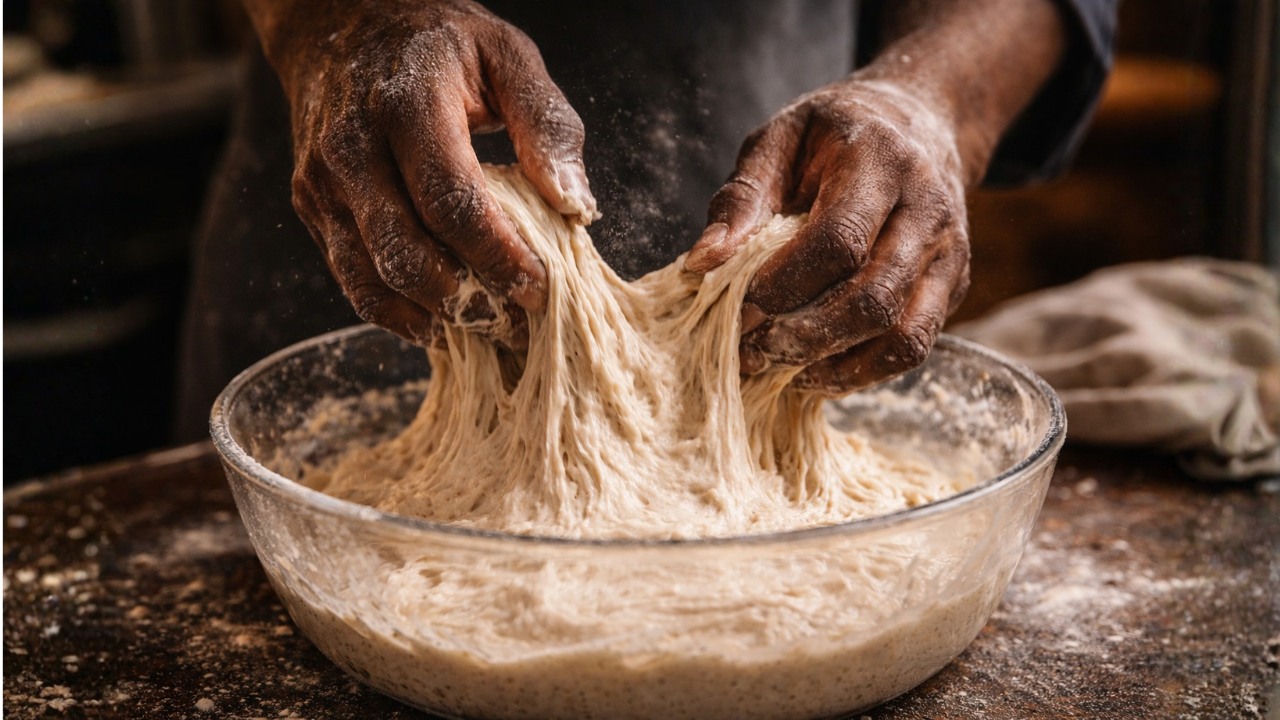
Every week inside Crust & Crumb Academy, someone posts a photo of their dough and asks the same question.
“Is this right? It seems really wet.”
The answer is almost always yes, and here’s why the fear keeps showing up even among bakers who’ve been at it for years.If you’ve ever panicked mid-bake, wondering whether your high hydration bread dough was ruined, you’re in the right place.
The Fear Is About Expectation, Not Skill
Most new bakers learn on sandwich bread or a simple dinner roll. Those doughs are usually in the 60-65% hydration range. Firm. Shapeable. They feel like playdough in your hands.
Then the baker tries to make a ciabatta or a focaccia or a rustic sourdough. The recipe calls for 75% hydration, or 80%, or higher. The dough comes out of the bowl looking like something that shouldn’t be called dough at all.
Panic sets in. The instinct says add flour. Fix it. Turn it into what it’s supposed to look like.
That instinct is the problem.High hydration bread rewards patience, not force.
What Hydration Actually Means
Hydration is the ratio of water to flour in your dough, measured by weight.
500 grams of flour and 400 grams of water is 80% hydration. 500 grams of flour and 325 grams of water is 65% hydration.
That’s it. The math is simple. What’s less simple is how dramatically different those two doughs behave.

A 65% dough holds its shape on the counter. You can pick it up and hand it around. It takes kneading gracefully and doesn’t feel alive in your hands.
An 80% dough pools. It stretches. It sticks to everything it touches. It looks wrong because you’ve been trained by experience to expect something firmer.
Neither is correct or incorrect. They’re just different tools for different breads.
Why Higher Hydration Exists in the First Place
You don’t push hydration higher for fun. You push it higher because of what it does to the final bread.
More water means more steam during baking. Steam is what opens up the crumb from the inside, creating those big irregular holes you see in ciabatta and focaccia. Without enough water in the dough, there’s nothing to turn into steam. The crumb stays tight.
Higher hydration also changes how flavor develops. A wetter dough ferments more actively, producing more of the organic acids and aromatic compounds that give bread real character. A 65% dough and an 80% dough made from the same flour with the same yeast can taste measurably different.
And here’s the kicker. Higher hydration is actually more forgiving on bake day, not less. A well-fermented 80% dough shrugs off minor timing mistakes in ways a 60% dough cannot. The extra water and the extra fermentation give you more margin.
The Three Fears That Kill High-Hydration Bakes
Three specific fears cause most high-hydration failures, and none of them have to do with baking skill.
Fear one: this dough is too wet, I need to add flour.
Adding flour mid-mix changes everything downstream. Your hydration drops. Your gluten tightens. Your fermentation slows. The bread you were trying to make becomes a different bread. And almost always, a worse one.
Fear two: this dough isn’t going to hold together.
It will. Gluten develops through time and folds, not just through kneading. Wait. Trust the process. The first coil fold always feels like the dough is hopeless. By the third fold, it’s transformed.
Fear three: I’m doing something wrong because it doesn’t look like the video.
Your kitchen temperature is different. Your flour is different. Your hands are different. The dough will always look slightly different from batch to batch, even in a professional bakery. Read the dough in front of you, not the one on the screen.
How to Actually Handle It
The tools you use matter more than the strength in your hands.
Wet hands, not floured hands. Water keeps the dough from sticking to you. Flour just absorbs into the dough and changes the hydration as you work.
A metal bench scraper. Plastic scrapers flex and skip. Metal slides under wet dough cleanly and does the work for you.
A digital scale. At 80% hydration, volume measurements lie. A cup of flour scooped one way versus another can vary by 30 grams. Weight is the only honest measurement.
A clear bowl for bulk fermentation. You want to see the gas developing without lifting a lid. Clear containers pay for themselves the first time you watch the dough come alive.
Coil folds, not stretch and folds. A coil fold lifts the dough gently from the center and lets it fold under itself. That gentleness preserves the bubbles that fermentation is creating. Aggressive handling pops the very structure you’re trying to build.

When It All Clicks
The first time you pull a proper ciabatta out of the oven, the fear goes away for good.
You’ll see a crackly, blistered crust. You’ll hear the crust sing as it cools. You’ll tear into it and see an open, honeycombed interior that you didn’t know you could make.
And you’ll realize the dough was never wrong. Your expectation was.
High hydration isn’t hard. It’s just unfamiliar.

This Saturday
We’re baking a Rustic Italian Ciabatta together inside Crust & Crumb Academy this Saturday. Two paths available: a classic yeasted version built on an overnight poolish, and a sourdough version built on an active levain. Both land at 80% hydration. Both produce that signature open crumb and crackly crust.
If you’ve been putting off your first high-hydration bake, this is the week to do it alongside hundreds of other bakers who are going to pour sticky dough onto their counters Saturday morning and trust it anyway.
The recipes are in the Recipe Pantry now. Rustic Italian Ciabatta (Yeasted) and Sourdough Italian Ciabatta.
Mix the preferment Friday night. Bake Saturday morning. I’ll be in the kitchen and in the thread all day.
Come bake with us.
Join hundreds of bakers inside Crust & Crumb Academy.

Perfection is not required. Progress is.
Henry


Leave a Reply