
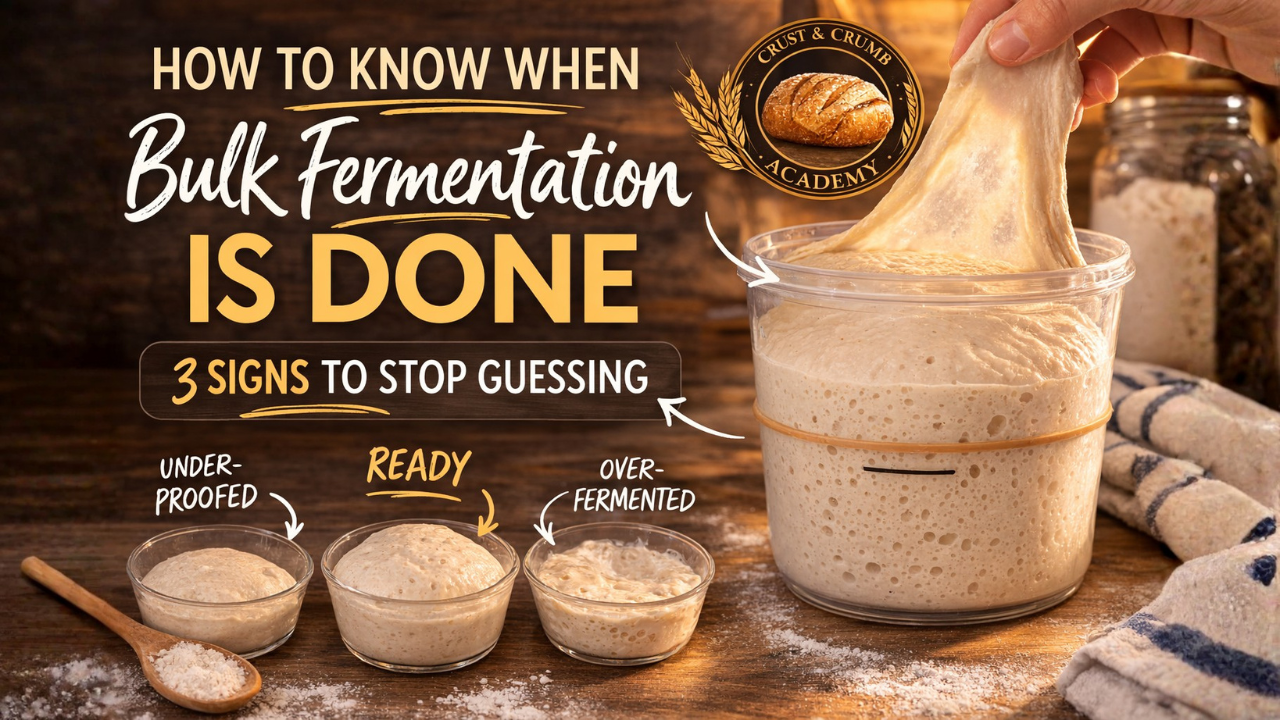

You’ve mixed your dough. You’ve done your folds. Now you’re staring at a container, wondering if it’s ready. Here’s the thing about bulk fermentation sourdough bakers struggle with most: knowing when it’s actually done.
Not when the recipe says it should be done. Not when the timer goes off. When the dough says it’s done.
Because a recipe can tell you “4 to 6 hours at room temperature.” But your room isn’t my room. Your starter isn’t my starter. And if you pull the dough too early, you’ll get a dense, gummy loaf. Wait too long, and it’ll spread flat on the counter like it gave up on life.
So forget the clock for a minute. Here are the three signs that actually matter.
Why Bulk Fermentation Timing Is the Make-or-Break Moment
Bulk fermentation is where your dough develops flavor, structure, and gas. It’s the longest single phase in sourdough baking, and it’s where most problems start. Not during shaping. Not during scoring. Right here.
If you’ve ever pulled a loaf from the oven and thought “what went wrong,” there’s a good chance the answer lives in your bulk fermentation. The dough wasn’t ready, or it went too far. That’s why learning to read these signs matters more than memorizing times.
If you’re newer to sourdough and still building your foundation, the Crust & Crumb Bread Baking Glossary is a solid reference for any terms that come up here.
Sign #1: Volume Increase of 50-75%
This is the most visible indicator. Your dough should grow by roughly 50 to 75 percent from where it started. Not double. That’s a common misconception, and it’s the reason a lot of bakers over-ferment without realizing it.
Use a straight-sided, clear container. Mark the starting level with a rubber band or a piece of tape. Then check it. You’re looking for that dough to rise about halfway to three-quarters above that mark.
A few things to keep in mind. If your kitchen is cold (below 70°F), this will take longer. If it’s warm (above 78°F), it’ll happen faster than you expect. Temperature drives fermentation speed more than anything else. That’s worth remembering every single bake.
If you’re working with a pre-ferment like a poolish or levain, your bulk may move quicker because part of the fermentation happened before the final mix.

Sign #2: The Dough Is Domed, Smooth, and Jiggly
Look at the surface. At the start of bulk, your dough is shaggy and uneven. When fermentation is working, gluten is developing and gas is building. The surface smooths out. The top becomes slightly domed rather than flat.
Now give the container a gentle shake or a light tap on the counter. The dough should jiggle, almost like Jell-O. That wobble tells you gas has been trapped inside a well-developed gluten network. It’s alive in there.
If the dough looks flat, sticky on top, or hasn’t changed texture since your last fold, it’s not done. Be patient. If it looks like it’s pulling away from the sides of the container and the surface is bubbly and irregular, you may have gone too far.
Sign #3: The Windowpane Holds and Bubbles Are Visible
Pull off a small piece of dough and gently stretch it between your fingers. If you can stretch it thin enough to see light through it without it tearing, that’s the windowpane test. It means your gluten structure is strong enough to hold the gas produced during fermentation.
At the same time, look at the edges of the dough where it meets the container. You should see small to medium bubbles just below the surface. Not a few random ones. A consistent pattern that tells you fermentation is active and distributed throughout the dough.
When you’ve got the windowpane and visible bubbles and the right volume increase, you’re done. That’s the trifecta. Move to shaping with confidence.

What to Do Right Now
Next time you bake, try this. Ignore the recipe’s time window completely. Instead, mark your container, watch for these three signs, and take notes. Write down the temperature of your kitchen and how long bulk actually took.
After three or four bakes, you’ll start to see your own pattern. Your kitchen, your starter, your flour. That’s when sourdough stops being a guessing game and starts being a skill.
This is the kind of process thinking that changes everything. It’s the same mindset behind getting your head in the game before you even touch flour.
If you want to put this into practice with a tested recipe, the Hybrid Sourdough Sandwich Bread is a great place to start. It’s forgiving, it’s practical, and it’ll let you focus on reading your dough instead of stressing about technique.
And if you’re looking for more recipes to sharpen your instincts, the Recipe Pantry has a growing library of tested sourdough and yeasted recipes, all free, with baker’s math and dual measurements built in.
One Tool That Takes the Guesswork Out of Your Starter
Inconsistent starter is one of the biggest reasons bulk fermentation is unpredictable. If your starter is running cold or sluggish, your dough will too, and no amount of visual watching will save an underactive ferment.
The SourHouse Goldie keeps your starter at the exact temperature it needs, year-round. No more babying it in the oven with the light on. No more guessing whether it’s warm enough in your kitchen.
If you want more consistent bakes, this is the tool that makes it happen.

Want to put this into practice with a community behind you?

Every Saturday, bakers inside Crust & Crumb Academy bake together in real time. You post your progress, ask questions mid-bake, and get coaching on exactly what you’re seeing, not generic advice.
That’s where skills like reading bulk fermentation go from concept to instinct.
Leave a Reply