Every spring, the same question pops up in baking communities: “Can I really make hot cross buns at home?” The short answer is yes, and with the right hot cross buns recipe, yours will be softer and more flavorful than anything from a bakery shelf.
But here’s the thing. Most people don’t know why they’re making them. And that “why” is what makes the bake worth doing.
A Bun with a 700-Year Paper Trail
Hot cross buns didn’t start in a supermarket plastic clamshell. The earliest version we can trace goes back to 1361, when a monk named Thomas Rocliffe baked sweet, fruit-studded buns marked with a cross and handed them out to the poor on Good Friday at St. Albans Abbey.
The tradition runs even deeper. The Saxons baked cross-marked buns in honor of Eostre, their goddess of spring, long before Christianity adopted the symbol. Ancient Egyptians scored small round loaves with crosses too, dividing them into four sections representing the phases of the moon.

By the time Queen Elizabeth I came along, hot cross buns had become so popular that the Crown saw them as a threat to the Church of England. In 1592, a decree banned their sale except on Good Friday, Christmas, and at funerals. People responded the way people always do when you tell them they can’t have bread. They baked them in secret.
The street cry everyone knows, “One a penny, two a penny, hot cross buns,” first appeared in Poor Robin’s Almanac in 1733. The Victorian era added the dried fruits and warm spices we associate with them today.
So when you shape a hot cross bun, you’re picking up a tradition that bakers have carried forward for centuries. That’s not a bad thing to think about while your dough is proofing.
Why These Hot Cross Buns Recipe Versions Are Different
Most hot cross bun recipes produce something that’s good on day one and a doorstop by day two. Ours use the tangzhong method, a cooked flour-and-milk paste that gelatinizes the starch before it ever hits the dough. The result: buns that stay soft for 2-3 days without any preservatives or tricks.
We also have two versions. A yeasted version you can start and finish in an afternoon, and a sourdough version that uses an overnight sweet levain built to favor lactic acid over acetic, so you get depth of flavor without sourness.
Both recipes use the same warm spice blend: cinnamon, allspice, nutmeg, and cardamom. Here’s something most recipes won’t tell you: cinnamon is naturally antifungal. It actually slows yeast activity. In a standard lean dough, that’s a problem. In an enriched dough loaded with butter, eggs, and sugar, it’s an advantage, because those enrichments already slow fermentation. The cinnamon acts as a built-in brake that prevents over-proofing.

The Cross: Traditional vs. Modern
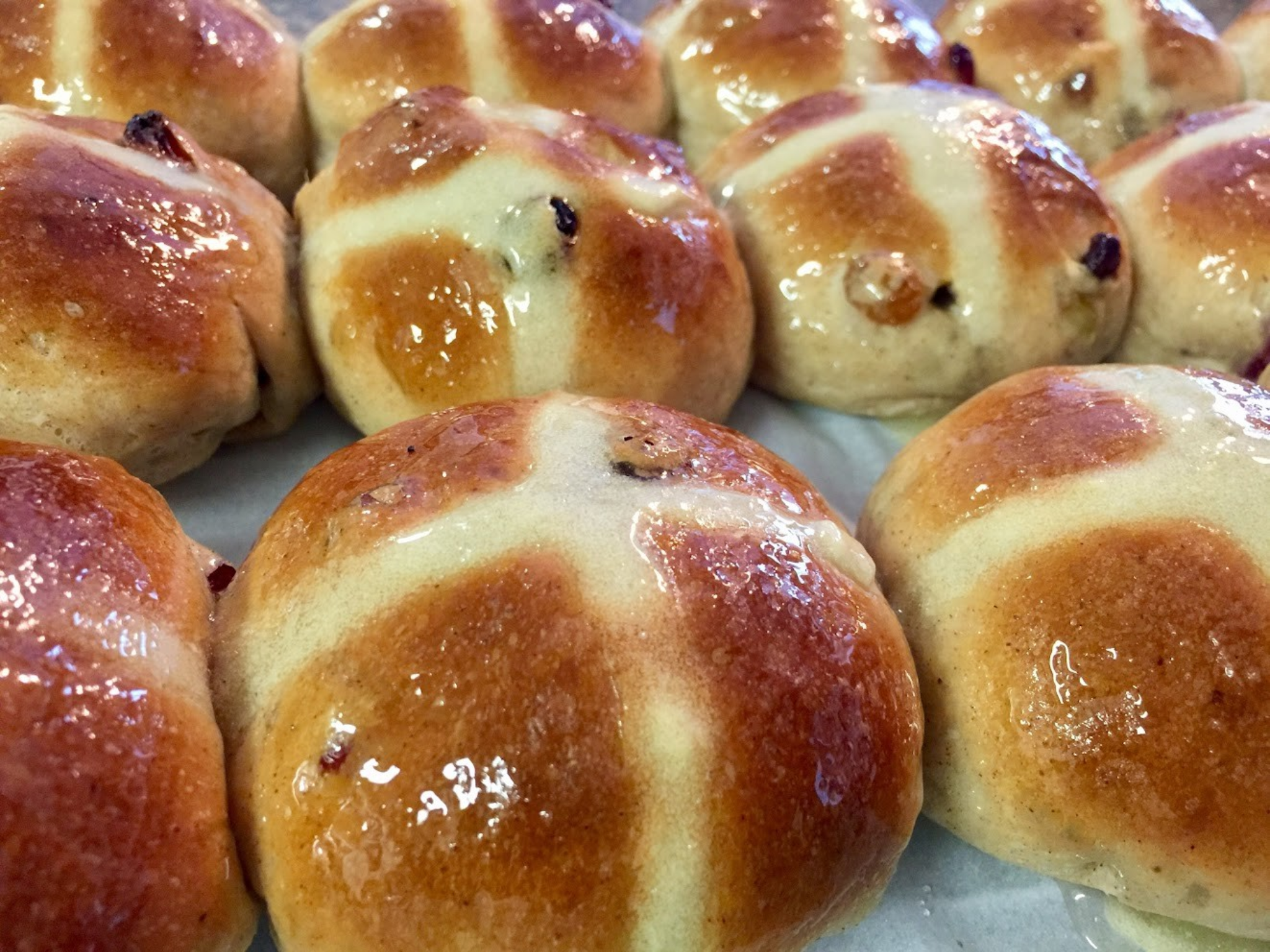
You’ll see two approaches out there. The modern shortcut is piping icing crosses after the bake. It’s easier, sure. But the traditional method, piping a simple flour paste (flour, water, a pinch of sugar) onto the buns before they go in the oven, gives you a cross that bakes right into the surface. It becomes part of the bun instead of sitting on top of it.
Both of our recipes use the traditional flour paste method. If you’ve never done it, don’t overthink it. A zip-lock bag with a corner snipped off works perfectly.
The Fruit Soak (Don’t Skip This)
Dried currants and candied orange peel get soaked in hot black tea or juice for at least 30 minutes before they go into the dough. This isn’t optional. Dry fruit dropped into wet dough will pull moisture from the crumb around it, leaving you with dry pockets in an otherwise soft bun. Pre-soaked fruit has already absorbed what it needs, so it gives flavor without stealing moisture.

Two Ways In
Yeasted Hot Cross Buns – Start to finish in about 4 hours. The tangzhong does all the heavy lifting for texture. Shape your 12 buns at 85-90g each, pack them into a 9×13 pan so they proof up against each other (that’s what gives you those soft, pull-apart sides), and bake at 400F for 20-25 minutes.
Sourdough Hot Cross Buns – Build your sweet levain the night before. The overnight bulk ferment does double duty: developing flavor and fitting the bake into your morning schedule. Final proof runs 2-3 hours, then the same bake. The sourdough version has a more complex flavor, but it won’t taste sour. The sweet levain and all that butter make sure of that.
Both recipes are on the Recipe Pantry with full step-by-step instructions, baker’s math, and troubleshooting notes.

More Easter Bakes Worth Your Weekend
If hot cross buns put you in the Easter baking mood, you’re in the right place. The Recipe Pantry is a free, ad-free destination for tested bread recipes, yeasted and sourdough, with baker’s math included.
Click an image below


Your Move
Easter is right around the corner. Pick a version, yeasted if you want same day results, sourdough if you want the overnight project, and give it a shot this weekend. Hot cross buns are one of those bakes that look harder than they are. The dough is forgiving, the shaping is simple, and the apricot glaze at the end covers a multitude of sins.
If you’re inside Crust & Crumb Academy, bring your bake to the Saturday bake-along. We’d love to see your crosses.

Join Crust & Crumb Academy. Step-by-step courses, Saturday bake-alongs, real feedback, and a community that’s in it with you.
“Where bakers come not to get likes but to get better.”
Don’t take my word for it. See what our members are saying.
